





SciScore
Company Details
Linkedin ID:
sciscore
Website:
Employees number:
None employees
Number of followers:
333
NAICS:
5417
Industry Type:
Homepage:
sciscore.com
IP Addresses:
0
Company ID:
SCI_3498833
Scan Status:
In-progress

SciScore Company CyberSecurity Posture
sciscore.com


SciScore scans submitted methods sections for sentences that describe antibodies, cell lines, organisms and tools (e.g., statistical software) then creates a key resources, prototype "STAR table." SciScore also tests the percent of key biological resources that should have a research resource identifier, RRID, and the percent that do have an RRID.
Company Details
sciscore
None employees
333
5417
sciscore.com
0
SCI_3498833
In-progress
 SciScore Risk Score (AI oriented)
Between 700 and 749
 SciScore Global Score (TPRM)
XXXX
Description: **Supply Chain Cybersecurity: Why Compliance Checks Fall Short in 2024** A recent industry discussion, led by cybersecurity experts including "Cyber Santa" Steve from **SecurityScorecard**, highlights a critical disconnect in how organizations manage third-party risk. Despite **88% of cybersecurity leaders expressing high concern** about supply chain breaches—with attacks rising **30-40%** in recent years—**93% still claim their security measures are effective**. The data suggests a troubling reality: many programs prioritize **compliance checkboxes** over actual risk reduction. ### **The Problem: A False Sense of Security** Supply chain attacks have surged as threat actors exploit vulnerabilities in vendors for **economies of scale**, targeting weak links to deploy ransomware or exfiltrate data. Yet most organizations rely on **annual questionnaires** or superficial vendor assessments, assuming breaches won’t happen—or worse, waiting for vendors to report incidents after the fact. This reactive approach leaves gaps: while internal security teams assume breach scenarios and execute response playbooks, third-party risk management often lacks the same rigor. ### **The Shift: From Compliance to Resilience** SecurityScorecard advocates moving toward a **security operations mindset** for third-party risk, mirroring internal incident response protocols. Key steps include: - **Vendor categorization**: Classifying suppliers by criticality (high/medium/low risk) to prioritize oversight. - **Evidence-based assessments**: Replacing self-reported questionnaires with **continuous monitoring** and threat intelligence. - **Incident response playbooks**: Developing **predefined actions** (e.g., shutting down API connections) rather than relying on vendor disclosures. - **Tabletop exercises**: Simulating breaches with vendors to test remediation workflows. - **Fourth-party risk visibility**: Tracking vulnerabilities in vendors’ *vendors* (e.g., cloud providers like AWS or Cloudflare) to anticipate cascading failures. ### **The Maturity Path** Organizations typically progress through four stages: 1. **Basic diligence**: One-time security reviews during onboarding. 2. **Early-stage policies**: Informal workflows and vendor categorization. 3. **Standardization**: Formalized assessments, evidence collection, and incident simulations. 4. **Advanced resiliency**: AI-driven workflows, **fourth-party risk mapping**, and integrated threat intelligence. ### **The Impact** The consequences of inaction are clear. Attackers increasingly target supply chains for **higher ROI**, and traditional compliance measures fail to address dynamic threats. Firms adopting **proactive, data-driven approaches**—like those using SecurityScorecard’s platform—report **improved vendor transparency, faster response times, and stronger cyber posture**. The goal isn’t just to check boxes but to **assume breach** and build resilience against inevitable disruptions. The message is stark: **2026’s cybersecurity battles will be won or lost in the supply chain**. The time to move beyond compliance is now.


SciScore has 53.85% more incidents than the average of same-industry companies with at least one recorded incident.
SciScore has 28.21% more incidents than the average of all companies with at least one recorded incident.
SciScore reported 1 incidents this year: 1 cyber attacks, 0 ransomware, 0 vulnerabilities, 0 data breaches, compared to industry peers with at least 1 incident.
SciScore cyber incidents detection timeline including parent company and subsidiaries

SciScore scans submitted methods sections for sentences that describe antibodies, cell lines, organisms and tools (e.g., statistical software) then creates a key resources, prototype "STAR table." SciScore also tests the percent of key biological resources that should have a research resource identifier, RRID, and the percent that do have an RRID.

Los Alamos National Laboratory is one of the world’s most innovative multidisciplinary research institutions. We're engaged in strategic science on behalf of national security to ensure the safety and reliability of the U.S. nuclear stockpile. Our workforce specializes in a wide range of progressive

Delft University of Technology (TU Delft) is a leading technical university in the Netherlands, known for our world-class engineering, science and design education. We offer top-ranked education and PhD programmes, and we conduct cutting-edge research that addresses global challenges. TU Delft play

UCL (University College London) is London's leading multidisciplinary university, ranked 9th in the QS World University Rankings. Established in 1826 UCL opened up education in England for the first time to students of any race, class or religion and was also the first university to welcome female

At Utrecht University (UU), we are working towards a better world. We do this by researching complex issues beyond the borders of disciplines. We put thinkers in contact with doers, so new insights can be applied. We give students the space to develop themselves. In so doing, we make substantial con

The Chinese Academy of Sciences (CAS) is the lead national scientific institution in natural sciences and high technology development in China and the country's supreme scientific advisory body. It incorporates three major parts: a comprehensive research and development network consisting of 104 res

The University of Cambridge is one of the world's foremost research universities. The University is made up of 31 Colleges and over 150 departments, faculties, schools and other institutions. Its mission is 'to contribute to society through the pursuit of education, learning, and research at the hi

Imagine what you could do at a world-leading university that is globally recognised for its teaching, research and innovation. The University of Edinburgh has been providing students with world-class teaching for more than 425 years, unlocking the potential of some of the world's leading thinkers

The French National Centre for Scientific Research is among the world's leading research institutions. Its scientists explore the living world, matter, the Universe, and the functioning of human societies in order to meet the major challenges of today and tomorrow. Internationally recognised for the

The CEA is the French Alternative Energies and Atomic Energy Commission ("Commissariat à l'énergie atomique et aux énergies alternatives"). It is a public body established in October 1945 by General de Gaulle. A leader in research, development and innovation, the CEA mission statement has two main
.png)
Mashable readers can save 50% on 1Password. This discount applies to both the Individual and Families plans.
The national cybersecurity index is a global live index of a country measured on its preparedness to prevent cyber threats and manage cyber...
The government is a client of leading cybersecurity ratings firm SecurityScorecard, which carried out the risk assessment, and subscribes to its...
TELFORD, PA — Draeger, Inc., a subsidiary of the Dräger group of corporations, has achieved Cybersecurity Maturity Model Certification...
The company's 110/110 assessment score confirms the maturity, rigor, and real-world readiness of its program to meet DoD standards and...
TELFORD, Pa., Oct. 29, 2025 /PRNewswire/ -- Draeger, Inc., part of the Dräger group of corporations ('Dräger') and a leading provider of medical...
The U.S. Cybersecurity and Infrastructure Security Agency (CISA) on Wednesday added a critical security flaw impacting Adobe Experience...
Microsoft has patched an ASP.NET Core vulnerability with a CVSS score of 9.9, which security program manager Barry Dorrans said was "our...
CyberSheath, a CMMC managed service vendor, partnered with CIS Secure, a secure collaboration solutions provider, to complete the...

Explore insights on cybersecurity incidents, risk posture, and Rankiteo's assessments.
The official website of SciScore is https://www.sciscore.com/.
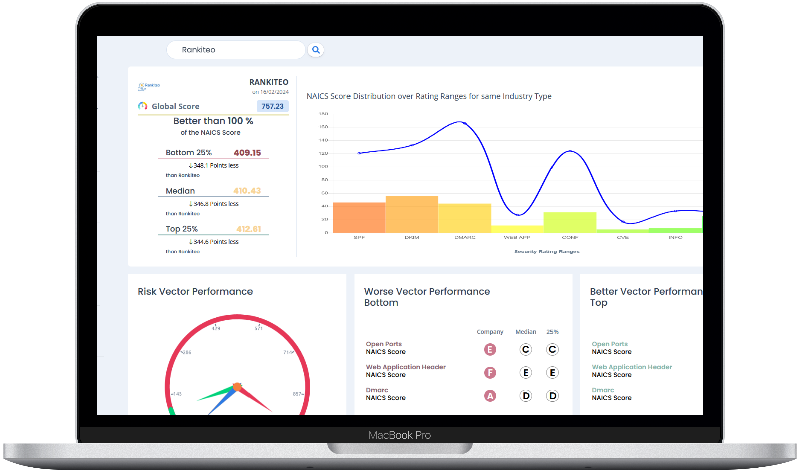
According to Rankiteo, SciScore’s AI-generated cybersecurity score is 734, reflecting their Moderate security posture.
According to Rankiteo, SciScore currently holds 0 security badges, indicating that no recognized compliance certifications are currently verified for the organization.
According to Rankiteo, SciScore is not certified under SOC 2 Type 1.
According to Rankiteo, SciScore does not hold a SOC 2 Type 2 certification.
According to Rankiteo, SciScore is not listed as GDPR compliant.
According to Rankiteo, SciScore does not currently maintain PCI DSS compliance.
According to Rankiteo, SciScore is not compliant with HIPAA regulations.
According to Rankiteo,SciScore is not certified under ISO 27001, indicating the absence of a formally recognized information security management framework.
SciScore operates primarily in the Research Services industry.
SciScore employs approximately None employees people worldwide.
SciScore presently has no subsidiaries across any sectors.
SciScore’s official LinkedIn profile has approximately 333 followers.
SciScore is classified under the NAICS code 5417, which corresponds to Scientific Research and Development Services.
No, SciScore does not have a profile on Crunchbase.
Yes, SciScore maintains an official LinkedIn profile, which is actively utilized for branding and talent engagement, which can be accessed here: https://www.linkedin.com/company/sciscore.
As of December 23, 2025, Rankiteo reports that SciScore has experienced 1 cybersecurity incidents.
SciScore has an estimated 5,181 peer or competitor companies worldwide.
Incident Types: The types of cybersecurity incidents that have occurred include Cyber Attack.
Detection and Response: The company detects and responds to cybersecurity incidents through an incident response plan activated with recommended: activate incident response playbooks for vendors, conduct tabletop exercises, and third party assistance with security scorecard and similar platforms for continuous monitoring and risk assessment, and containment measures with shutting down api connections, isolating affected systems, enhanced monitoring, and remediation measures with patch management, evidence-based security assessments, automated vendor detection, and recovery measures with restoration of services, vendor collaboration for breach resolution, and communication strategy with proactive communication with vendors and stakeholders, transparency in incident handling, and enhanced monitoring with continuous monitoring of vendors and sub-vendors, threat intelligence integration..
Title: Supply Chain Breaches and Third-Party Risk Management Challenges
Description: Discussion on the increasing prevalence of supply chain breaches, the discrepancy between perceived effectiveness of third-party risk management programs and actual concerns, and the shift from compliance-driven to security operations-driven third-party risk programs. Highlights the need for proactive measures, incident response playbooks, and continuous monitoring of vendors and their sub-vendors (4th party risk).
Type: Supply Chain Breach
Attack Vector: Third-party vendors, vulnerabilities in supply chain, ransomware, API connections
Vulnerability Exploited: Unpatched systems, lack of continuous monitoring, weak incident response playbooks, compliance-only mindset
Motivation: Financial gain, data exfiltration, ransomware deployment, economies of scale in attacks
Common Attack Types: The most common types of attacks the company has faced is Cyber Attack.
Identification of Attack Vectors: The company identifies the attack vectors used in incidents through Third-party vendors and supply chain vulnerabilities.

Data Compromised: Potential data exfiltration, personally identifiable information (PII), payment information
Systems Affected: Vendor systems, API connections, cloud services (e.g., AWS, Cloudflare), firewalls
Downtime: Potential operational downtime due to vendor outages or breaches
Operational Impact: Disruption of services, loss of control over vendor relationships, delayed incident response
Brand Reputation Impact: Potential reputational damage due to third-party breaches
Legal Liabilities: Potential regulatory violations and fines
Identity Theft Risk: High risk due to exposure of PII
Payment Information Risk: High risk due to exposure of payment data
Commonly Compromised Data Types: The types of data most commonly compromised in incidents are Personally Identifiable Information (Pii), Payment Information, Corporate Data and .
Entity Type: Organizations using third-party vendors
Industry: Multiple industries (financial, technology, cloud services, etc.)
Size: All sizes, particularly enterprises
Customers Affected: Potentially millions due to supply chain scale
Incident Response Plan Activated: Recommended: Activate incident response playbooks for vendors, conduct tabletop exercises
Third Party Assistance: Security Scorecard and similar platforms for continuous monitoring and risk assessment
Containment Measures: Shutting down API connections, isolating affected systems, enhanced monitoring
Remediation Measures: Patch management, evidence-based security assessments, automated vendor detection
Recovery Measures: Restoration of services, vendor collaboration for breach resolution
Communication Strategy: Proactive communication with vendors and stakeholders, transparency in incident handling
Enhanced Monitoring: Continuous monitoring of vendors and sub-vendors, threat intelligence integration
Incident Response Plan: The company's incident response plan is described as Recommended: Activate incident response playbooks for vendors, conduct tabletop exercises.
Third-Party Assistance: The company involves third-party assistance in incident response through Security Scorecard and similar platforms for continuous monitoring and risk assessment.
Type of Data Compromised: Personally identifiable information (pii), Payment information, Corporate data
Sensitivity of Data: High (PII, payment data, corporate secrets)
Data Exfiltration: Potential data exfiltration by threat actors
Personally Identifiable Information: Yes
Prevention of Data Exfiltration: The company takes the following measures to prevent data exfiltration: Patch management, evidence-based security assessments, automated vendor detection.
Handling of PII Incidents: The company handles incidents involving personally identifiable information (PII) through by shutting down api connections, isolating affected systems and enhanced monitoring.
Data Encryption: Potential data encryption during ransomware attacks
Data Exfiltration: Potential data exfiltration before encryption
Data Recovery from Ransomware: The company recovers data encrypted by ransomware through Restoration of services, vendor collaboration for breach resolution.
Lessons Learned: Compliance-driven third-party risk programs are insufficient. Organizations must adopt a security operations mindset, implement continuous monitoring, and develop incident response playbooks for vendors. Proactive measures, such as categorizing vendors and conducting tabletop exercises, are critical for supply chain resiliency.
Recommendations: Categorize vendors by criticality (high, medium, low)., Develop incident response playbooks for third-party breaches., Conduct tabletop exercises with vendors., Implement continuous monitoring of vendors and sub-vendors (4th party risk)., Shift from compliance-driven to security operations-driven third-party risk management., Use threat intelligence and automated vendor detection tools., Establish direct communication channels with critical vendors for incident response.Categorize vendors by criticality (high, medium, low)., Develop incident response playbooks for third-party breaches., Conduct tabletop exercises with vendors., Implement continuous monitoring of vendors and sub-vendors (4th party risk)., Shift from compliance-driven to security operations-driven third-party risk management., Use threat intelligence and automated vendor detection tools., Establish direct communication channels with critical vendors for incident response.Categorize vendors by criticality (high, medium, low)., Develop incident response playbooks for third-party breaches., Conduct tabletop exercises with vendors., Implement continuous monitoring of vendors and sub-vendors (4th party risk)., Shift from compliance-driven to security operations-driven third-party risk management., Use threat intelligence and automated vendor detection tools., Establish direct communication channels with critical vendors for incident response.Categorize vendors by criticality (high, medium, low)., Develop incident response playbooks for third-party breaches., Conduct tabletop exercises with vendors., Implement continuous monitoring of vendors and sub-vendors (4th party risk)., Shift from compliance-driven to security operations-driven third-party risk management., Use threat intelligence and automated vendor detection tools., Establish direct communication channels with critical vendors for incident response.Categorize vendors by criticality (high, medium, low)., Develop incident response playbooks for third-party breaches., Conduct tabletop exercises with vendors., Implement continuous monitoring of vendors and sub-vendors (4th party risk)., Shift from compliance-driven to security operations-driven third-party risk management., Use threat intelligence and automated vendor detection tools., Establish direct communication channels with critical vendors for incident response.Categorize vendors by criticality (high, medium, low)., Develop incident response playbooks for third-party breaches., Conduct tabletop exercises with vendors., Implement continuous monitoring of vendors and sub-vendors (4th party risk)., Shift from compliance-driven to security operations-driven third-party risk management., Use threat intelligence and automated vendor detection tools., Establish direct communication channels with critical vendors for incident response.Categorize vendors by criticality (high, medium, low)., Develop incident response playbooks for third-party breaches., Conduct tabletop exercises with vendors., Implement continuous monitoring of vendors and sub-vendors (4th party risk)., Shift from compliance-driven to security operations-driven third-party risk management., Use threat intelligence and automated vendor detection tools., Establish direct communication channels with critical vendors for incident response.
Key Lessons Learned: The key lessons learned from past incidents are Compliance-driven third-party risk programs are insufficient. Organizations must adopt a security operations mindset, implement continuous monitoring, and develop incident response playbooks for vendors. Proactive measures, such as categorizing vendors and conducting tabletop exercises, are critical for supply chain resiliency.
Implemented Recommendations: The company has implemented the following recommendations to improve cybersecurity: Conduct tabletop exercises with vendors., Use threat intelligence and automated vendor detection tools., Establish direct communication channels with critical vendors for incident response., Categorize vendors by criticality (high, medium, low)., Develop incident response playbooks for third-party breaches., Implement continuous monitoring of vendors and sub-vendors (4th party risk). and Shift from compliance-driven to security operations-driven third-party risk management..
Source: Security Scorecard Webinar
Source: Verizon Data Breach Investigations Report (DBIR)
Additional Resources: Stakeholders can find additional resources on cybersecurity best practices at and Source: Security Scorecard Webinar, and Source: Verizon Data Breach Investigations Report (DBIR).
Communication of Investigation Status: The company communicates the status of incident investigations to stakeholders through Proactive communication with vendors and stakeholders and transparency in incident handling.
Stakeholder Advisories: Proactive communication with stakeholders about third-party risks and mitigation strategies.
Customer Advisories: Transparent communication with customers about potential risks and protective measures.
Advisories Provided: The company provides the following advisories to stakeholders and customers following an incident: were Proactive communication with stakeholders about third-party risks and mitigation strategies. and Transparent communication with customers about potential risks and protective measures..
Entry Point: Third-party vendors, supply chain vulnerabilities
High Value Targets: Critical vendors with access to sensitive data or systems
Data Sold on Dark Web: Critical vendors with access to sensitive data or systems
Root Causes: Compliance-Only Mindset In Third-Party Risk Management, Lack Of Continuous Monitoring, Insufficient Incident Response Playbooks For Vendors, Over-Reliance On Vendor Questionnaires, Failure To Assess 4Th Party Risk,
Corrective Actions: Adopt A Security Operations Mindset For Third-Party Risk., Implement Continuous Monitoring And Threat Intelligence., Develop And Test Incident Response Playbooks With Vendors., Categorize Vendors And Prioritize Critical Ones., Conduct Regular Tabletop Exercises And Simulations.,
Post-Incident Analysis Process: The company's process for conducting post-incident analysis is described as Security Scorecard and similar platforms for continuous monitoring and risk assessment, Continuous monitoring of vendors and sub-vendors, threat intelligence integration.
Corrective Actions Taken: The company has taken the following corrective actions based on post-incident analysis: Adopt A Security Operations Mindset For Third-Party Risk., Implement Continuous Monitoring And Threat Intelligence., Develop And Test Incident Response Playbooks With Vendors., Categorize Vendors And Prioritize Critical Ones., Conduct Regular Tabletop Exercises And Simulations., .
Most Significant Data Compromised: The most significant data compromised in an incident were Potential data exfiltration, personally identifiable information (PII) and payment information.
Third-Party Assistance in Most Recent Incident: The third-party assistance involved in the most recent incident was Security Scorecard and similar platforms for continuous monitoring and risk assessment.
Containment Measures in Most Recent Incident: The containment measures taken in the most recent incident were Shutting down API connections, isolating affected systems and enhanced monitoring.
Most Sensitive Data Compromised: The most sensitive data compromised in a breach were Potential data exfiltration, personally identifiable information (PII) and payment information.
Most Significant Lesson Learned: The most significant lesson learned from past incidents was Compliance-driven third-party risk programs are insufficient. Organizations must adopt a security operations mindset, implement continuous monitoring, and develop incident response playbooks for vendors. Proactive measures, such as categorizing vendors and conducting tabletop exercises, are critical for supply chain resiliency.
Most Significant Recommendation Implemented: The most significant recommendation implemented to improve cybersecurity was Conduct tabletop exercises with vendors., Use threat intelligence and automated vendor detection tools., Establish direct communication channels with critical vendors for incident response., Categorize vendors by criticality (high, medium, low)., Develop incident response playbooks for third-party breaches., Implement continuous monitoring of vendors and sub-vendors (4th party risk). and Shift from compliance-driven to security operations-driven third-party risk management..
Most Recent Source: The most recent source of information about an incident are Security Scorecard Webinar and Verizon Data Breach Investigations Report (DBIR).
Most Recent Stakeholder Advisory: The most recent stakeholder advisory issued was Proactive communication with stakeholders about third-party risks and mitigation strategies., .
Most Recent Customer Advisory: The most recent customer advisory issued was an Transparent communication with customers about potential risks and protective measures.
Most Recent Entry Point: The most recent entry point used by an initial access broker were an Third-party vendors and supply chain vulnerabilities.
.png)
Marshmallow is a lightweight library for converting complex objects to and from simple Python datatypes. In versions from 3.0.0rc1 to before 3.26.2 and from 4.0.0 to before 4.1.2, Schema.load(data, many=True) is vulnerable to denial of service attacks. A moderately sized request can consume a disproportionate amount of CPU time. This issue has been patched in version 3.26.2 and 4.1.2.
KEDA is a Kubernetes-based Event Driven Autoscaling component. Prior to versions 2.17.3 and 2.18.3, an Arbitrary File Read vulnerability has been identified in KEDA, potentially affecting any KEDA resource that uses TriggerAuthentication to configure HashiCorp Vault authentication. The vulnerability stems from an incorrect or insufficient path validation when loading the Service Account Token specified in spec.hashiCorpVault.credential.serviceAccount. An attacker with permissions to create or modify a TriggerAuthentication resource can exfiltrate the content of any file from the node's filesystem (where the KEDA pod resides) by directing the file's content to a server under their control, as part of the Vault authentication request. The potential impact includes the exfiltration of sensitive system information, such as secrets, keys, or the content of files like /etc/passwd. This issue has been patched in versions 2.17.3 and 2.18.3.
Fedify is a TypeScript library for building federated server apps powered by ActivityPub. Prior to versions 1.6.13, 1.7.14, 1.8.15, and 1.9.2, a Regular Expression Denial of Service (ReDoS) vulnerability exists in Fedify's document loader. The HTML parsing regex at packages/fedify/src/runtime/docloader.ts:259 contains nested quantifiers that cause catastrophic backtracking when processing maliciously crafted HTML responses. This issue has been patched in versions 1.6.13, 1.7.14, 1.8.15, and 1.9.2.
Authenticated Remote Code Execution (RCE) in PluXml CMS 5.8.22 allows an attacker with administrator panel access to inject a malicious PHP webshell into a theme file (e.g., home.php).
An issue was discovered in Xiongmai XM530 IP cameras on firmware V5.00.R02.000807D8.10010.346624.S.ONVIF 21.06. The GetStreamUri exposes RTSP URIs containing hardcoded credentials enabling direct unauthorized video stream access.

Get company history

Every week, Rankiteo analyzes billions of signals to give organizations a sharper, faster view of emerging risks. With deeper, more actionable intelligence at their fingertips, security teams can outpace threat actors, respond instantly to Zero-Day attacks, and dramatically shrink their risk exposure window.
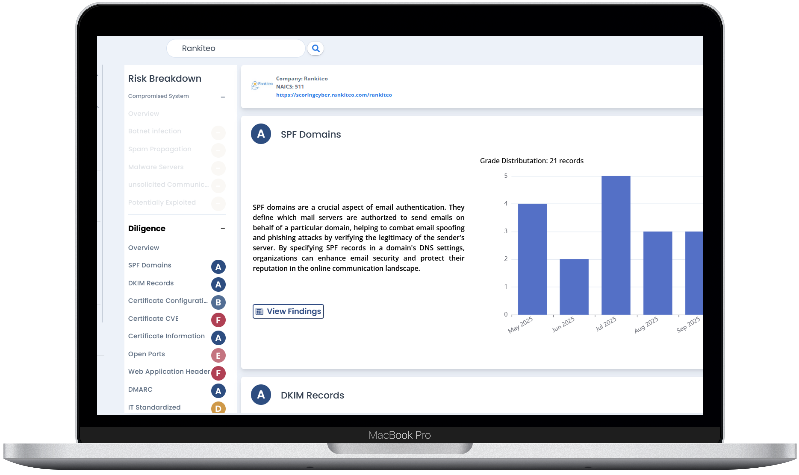
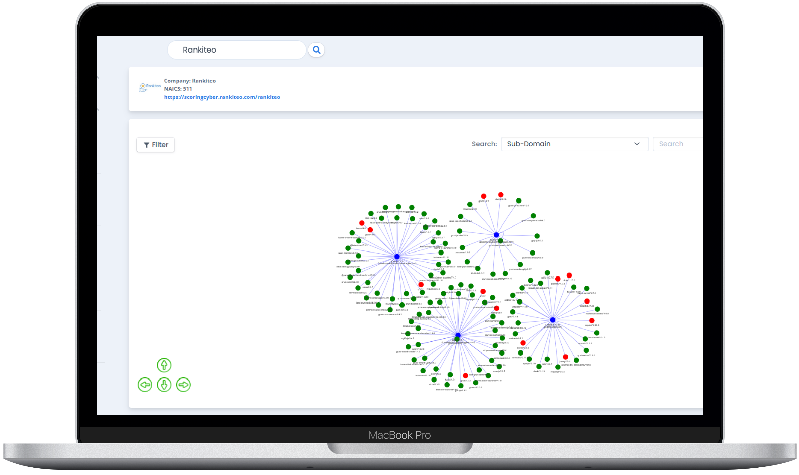
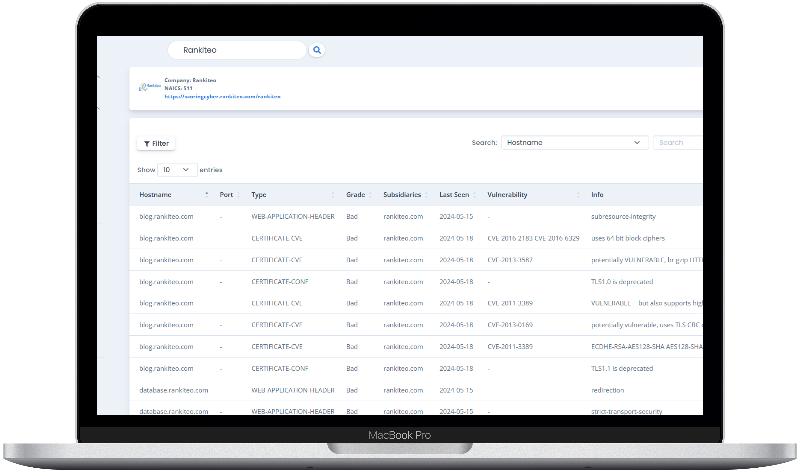
Identify exposed access points, detect misconfigured SSL certificates, and uncover vulnerabilities across the network infrastructure.
Gain visibility into the software components used within an organization to detect vulnerabilities, manage risk, and ensure supply chain security.
Monitor and manage all IT assets and their configurations to ensure accurate, real-time visibility across the company's technology environment.
Leverage real-time insights on active threats, malware campaigns, and emerging vulnerabilities to proactively defend against evolving cyberattacks.






 Rapid
Rapid