











RCT
Company Details
Linkedin ID:
royal-collection-trust
Website:
Employees number:
414
Number of followers:
24,455
NAICS:
712
Industry Type:
Homepage:
rct.uk
IP Addresses:
0
Company ID:
ROY_3320313
Scan Status:
In-progress


Royal Collection Trust Vendor Cyber Rating & Cyber Score
rct.ukRoyal Collection Trust is one of the five departments of the Royal Household. We care for the Royal Collection, one of the world's greatest art collections, and manage the public opening of the official residences of His Majesty The King – Buckingham Palace, Windsor Castle and the Palace of Holyroodhouse in Edinburgh. Our work is undertaken without public funding of any kind. Income generated from admissions, our shops and other commercial initiatives funds the conservation of the Royal Collection and projects to increase access to and enjoyment of the Collection, such as exhibitions, publications and educational programmes. We employ over 500 people in a wide range of roles, from conservators and curators to marketers and merchandisers. We also recruit around 350 summer staff each year to help our front-of-house teams create a memorable experience for millions of visitors from all over the world. With Royal Collection Trust, you will be trained, supported and inspired to achieve the highest standards. Collaboration is at the heart of what we do, and whatever your role, you will play a key part in ensuring that the Royal Collection and Palaces are valued and enjoyed by everyone.
Company Details
royal-collection-trust
414
24,455
712
rct.uk
0
ROY_3320313
In-progress
 RCT Risk Score (AI oriented)
Between 750 and 799
 RCT Global Score (TPRM)
XXXX


No incidents recorded for Royal Collection Trust in 2026.
No incidents recorded for Royal Collection Trust in 2026.
No incidents recorded for Royal Collection Trust in 2026.
RCT cyber incidents detection timeline including parent company and subsidiaries

Royal Collection Trust is one of the five departments of the Royal Household. We care for the Royal Collection, one of the world's greatest art collections, and manage the public opening of the official residences of His Majesty The King – Buckingham Palace, Windsor Castle and the Palace of Holyroodhouse in Edinburgh. Our work is undertaken without public funding of any kind. Income generated from admissions, our shops and other commercial initiatives funds the conservation of the Royal Collection and projects to increase access to and enjoyment of the Collection, such as exhibitions, publications and educational programmes. We employ over 500 people in a wide range of roles, from conservators and curators to marketers and merchandisers. We also recruit around 350 summer staff each year to help our front-of-house teams create a memorable experience for millions of visitors from all over the world. With Royal Collection Trust, you will be trained, supported and inspired to achieve the highest standards. Collaboration is at the heart of what we do, and whatever your role, you will play a key part in ensuring that the Royal Collection and Palaces are valued and enjoyed by everyone.


Our collection tells the story of the nation – our memories, lives and futures. The National Film and Sound Archive of Australia acknowledges Australia's Aboriginal and Torres Strait Islander peoples as the Traditional Custodians of the land on which we work and live and gives respect to their Elde

The Center for Statistics and Machine Learning (CSML) is Princeton University’s focal point for data science education and research on campus. The center’s mission is to foster and support a community of scholars addressing the challenges of modern algorithmic data-driven research, the development

The Contemporary Arts Center (CAC) is committed to artists, the presentation of multidisciplinary work, and the value and power of the art of our time. Formed in 1976 by a passionate group of visual and performing artists when the movement to tear down the walls between visual and performing arts

One of only two homes Thomas Jefferson designed for his personal use, Poplar Forest was the place where Jefferson “came to indulge in the life of the mind and renew his personal creativity.” Jefferson and his wife, Martha, inherited the Bedford County plantation known as Poplar Forest from her fathe

The National Cinema Museum in Turin is among the most important in the world for the richness of its heritage and the multiplicity of its scientific and popular activities. But what makes it truly unique is the peculiarity of its exhibition layout. The museum is housed inside the Mole Antonelliana,

Gesticht in 1935 als een museum voor stad en streek heeft Museum Jan Cunen zich vooral vanaf de jaren negentig ontwikkeld tot een dynamisch museum met een sterke, heldere profilering gericht op hedendaagse- en negentiende-eeuwse kunst, met educatie als speerpunt. De innovatieve aanpak van cultuured

Formerly, Southold Historical Society, we are a local history museum with a strong volunteer base and remarkable professional staff. Southold Historical Museum is one of the most beloved attractions on the North Fork, operating over a dozen historic buildings in Southold. The locations are: Prince B

The Ironbridge Gorge Museum Trust is a heritage conservation and education charity. We are home to 36 listed buildings across 10 sites which include some of the most important industrial heritage in the world. As well as hosting visitors and events we deliver award winning workshops. The 10 Ironbrid

The Wallace Collection is an internationally outstanding collection which contains unsurpassed masterpieces of paintings, sculpture, furniture, arms and armour and porcelain. Built over the eighteenth and nineteenth centuries by the Marquesses of Hertford and Sir Richard Wallace, it is one of the f
.png)
Successful cyber-attacks on hospitals can cost lives, which is why Royal Cornwall Hospitals NHS Trust decided to bolster its security and...
Your most-used apps might pose more danger than they're worth. Here's what you need to know about common apps that spy on you.
Smartcomply, an African-built digital trust and cybersecurity technology company, is making its formal entry into the Kenyan market with...
After experimenting with an outsourced Security Operations Centre (SOC), RMS shifted to Sophos MDR for proactive, global threat monitoring.
On November 25, 2024, the Strengthening Cyber Security and Building Trust in the Public Sector Act, 2024 (Bill 194) passed Third Reading and received Royal...
On November 25, 2024, the Strengthening Cyber Security and Building Trust in the Public Sector Act, 2024 (Bill 194) passed Third Reading and received Royal...
This holiday season's festive adornments include a 20-foot-tall tree and miniature decorations in Queen Mary's Dolls' House. Royal...
The Royal Household is advertising for a cybersecurity expert to head-up its team digitally defending King Charles, his family, and their workers.
King Charles is seeking a tech expert with a salary of £75000 a year who will protect computer systems at Buckingham Palace and prevent...

Explore insights on cybersecurity incidents, risk posture, and Rankiteo's assessments.
The official website of Royal Collection Trust is http://www.rct.uk.
According to Rankiteo, Royal Collection Trust’s AI-generated cybersecurity score is 766, reflecting their Fair security posture.
According to Rankiteo, Royal Collection Trust currently holds 0 security badges, indicating that no recognized compliance certifications are currently verified for the organization.
According to Rankiteo, Royal Collection Trust has not been affected by any supply chain cyber incidents, and no incident IDs are currently listed for the organization.
According to Rankiteo, Royal Collection Trust is not certified under SOC 2 Type 1.
According to Rankiteo, Royal Collection Trust does not hold a SOC 2 Type 2 certification.
According to Rankiteo, Royal Collection Trust is not listed as GDPR compliant.
According to Rankiteo, Royal Collection Trust does not currently maintain PCI DSS compliance.
According to Rankiteo, Royal Collection Trust is not compliant with HIPAA regulations.
According to Rankiteo,Royal Collection Trust is not certified under ISO 27001, indicating the absence of a formally recognized information security management framework.
Royal Collection Trust operates primarily in the Museums, Historical Sites, and Zoos industry.
Royal Collection Trust employs approximately 414 people worldwide.
Royal Collection Trust presently has no subsidiaries across any sectors.
Royal Collection Trust’s official LinkedIn profile has approximately 24,455 followers.
Royal Collection Trust is classified under the NAICS code 712, which corresponds to Museums, Historical Sites, and Similar Institutions.
No, Royal Collection Trust does not have a profile on Crunchbase.
Yes, Royal Collection Trust maintains an official LinkedIn profile, which is actively utilized for branding and talent engagement, which can be accessed here: https://www.linkedin.com/company/royal-collection-trust.
As of April 04, 2026, Rankiteo reports that Royal Collection Trust has not experienced any cybersecurity incidents.
Royal Collection Trust has an estimated 2,193 peer or competitor companies worldwide.
Total Incidents: According to Rankiteo, Royal Collection Trust has faced 0 incidents in the past.
Incident Types: The types of cybersecurity incidents that have occurred include .
.png)
Hirschmann EagleSDV version 05.4.01 prior to 05.4.02 contains a denial-of-service vulnerability that causes the device to crash during session establishment when using TLS 1.0 or TLS 1.1. Attackers can trigger a crash by initiating TLS connections with these protocol versions to disrupt service availability.
The stored API keys in temporary browser client is not marked as protected allowing for JavScript console or other errors to allow for extraction of the encryption credentials.
XSS vulnerability in cveInterface.js allows for inject HTML to be passed to display, as cveInterface trusts input from CVE API services
Multiple reflected cross-site scripting (XSS) vulnerabilities in the login.php endpoint of Interzen Consulting S.r.l ZenShare Suite v17.0 allows attackers to execute arbitrary Javascript in the context of the user's browser via a crafted URL injected into the codice_azienda and red_url parameters.
A reflected cross-site scripting (XSS) vulnerability in the login_newpwd.php endpoint of Interzen Consulting S.r.l ZenShare Suite v17.0 allows attackers to execute arbitrary Javascript in the context of the user's browser via a crafted URL injected into the codice_azienda parameter.

Get company history

Every week, Rankiteo analyzes billions of signals to give organizations a sharper, faster view of emerging risks. With deeper, more actionable intelligence at their fingertips, security teams can outpace threat actors, respond instantly to Zero-Day attacks, and dramatically shrink their risk exposure window.
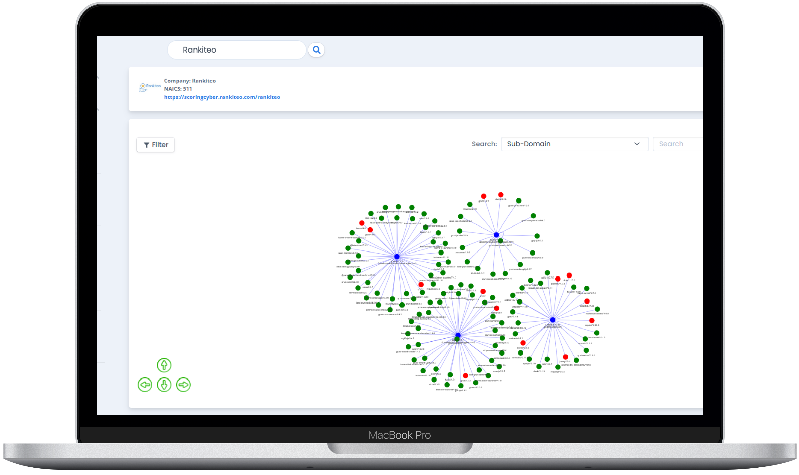
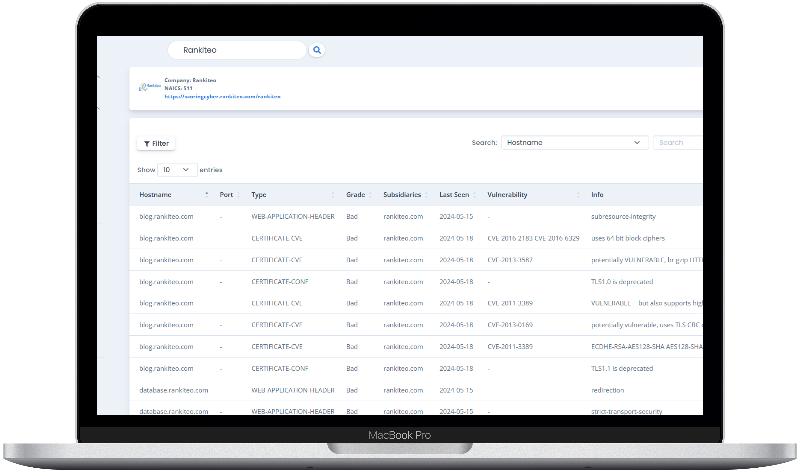
Identify exposed access points, detect misconfigured SSL certificates, and uncover vulnerabilities across the network infrastructure.
Gain visibility into the software components used within an organization to detect vulnerabilities, manage risk, and ensure supply chain security.
Monitor and manage all IT assets and their configurations to ensure accurate, real-time visibility across the company's technology environment.
Leverage real-time insights on active threats, malware campaigns, and emerging vulnerabilities to proactively defend against evolving cyberattacks.



 Rapid
Rapid