











MNDCDT
Company Details
Linkedin ID:
museo-nazionale-del-cinema-di-torino
Website:
Employees number:
110
Number of followers:
7,084
NAICS:
712
Industry Type:
Homepage:
museocinema.it
IP Addresses:
0
Company ID:
MUS_1721260
Scan Status:
In-progress


Museo Nazionale del Cinema di Torino Vendor Cyber Rating & Cyber Score
museocinema.itThe National Cinema Museum in Turin is among the most important in the world for the richness of its heritage and the multiplicity of its scientific and popular activities. But what makes it truly unique is the peculiarity of its exhibition layout. The museum is housed inside the Mole Antonelliana, a bizarre and fascinating monument and symbol of the City of Turin. All images posted on this page are for the use of cultural dissemination and all commercial purposes are excluded Buy tickets > https://cinema.museitorino.it/
Company Details
museo-nazionale-del-cinema-di-torino
110
7,084
712
museocinema.it
0
MUS_1721260
In-progress
 MNDCDT Risk Score (AI oriented)
Between 750 and 799
 MNDCDT Global Score (TPRM)
XXXX


No incidents recorded for Museo Nazionale del Cinema di Torino in 2026.
No incidents recorded for Museo Nazionale del Cinema di Torino in 2026.
No incidents recorded for Museo Nazionale del Cinema di Torino in 2026.
MNDCDT cyber incidents detection timeline including parent company and subsidiaries

The National Cinema Museum in Turin is among the most important in the world for the richness of its heritage and the multiplicity of its scientific and popular activities. But what makes it truly unique is the peculiarity of its exhibition layout. The museum is housed inside the Mole Antonelliana, a bizarre and fascinating monument and symbol of the City of Turin. All images posted on this page are for the use of cultural dissemination and all commercial purposes are excluded Buy tickets > https://cinema.museitorino.it/


The Hancock Historical Museum is a privately-funded, non-profit history museum founded in 1970 by five local civic leaders: Harold Corbin, Jack Harrington, Ed Heminger, Jim Brucklacher, and Joe Opperman. These five men had the foresight to create a place to preserve and share our local history. Over

The Issaquah History Museums discovers, preserves, and shares the history of Issaquah and the surrounding area. We are a vital part of keeping our community sustainable! To help share the story of our community, the Issaquah History Museums operate both the Issaquah Depot Museum and the Gilman T

The Rice Northwest Museum of Rocks and Minerals houses a world-class collection recognized as the finest in the Pacific Northwest and one of the best in the nation. Located just west of Portland, Oregon, in Hillsboro, the Museum showcases not only fine rocks and minerals, but also fossils, meteorite

We are the charity who love and look after Hampton Court Palace, Kensington Palace, Tower of London, the Banqueting House, Kew Palace, and Hillsborough Castle and Gardens. The palaces are the setting for the stories that shape us all, and we’re bringing them to people in ways that mean more to the

The Abraham Lincoln Presidential Library and Museum is a state-of-the-art facility meticulously designed to offer an immersive experience into the life and legacy of our nation’s 16th President. Through an impressive array of hi-tech exhibits, interactive displays, and multimedia programs—complement

Historic Rural Hill Inc. is a 501c-3 non-profit in Huntersville, NC that operates as a historic site, educational facility, 265 acre working farm, and event destination. Rural Hill annually hosts The Rural Hill Scottish Festival and Loch Norman Highland Games, Bark in the Park, The North Carolina Br

The Kurt Vonnegut Memorial Library champions the legacy of Hoosier author Kurt Vonnegut and the principles of free expression, common decency and peaceful coexistence he advocated. The only one of its kind in the nation, the Vonnegut Library serves as a museum, art gallery and lending library, as

The Military Aviation Museum is home to one of the largest flying collections of World War I and World War II era military aircraft in the world. The Museum and its incredible assemblage have their roots in a private collection begun by Gerald and Elaine Yagen of Virginia Beach, VA. First opened to

The Lone Star Flight Museum's (LSFM) mission is to celebrate flight and achievement in Texas aviation history; and educate and engage our youth through Science, Technology, Engineering and Math (STEM). Lead by Anna Hawley, LSFM opened its $38 million state-of-the-art museum on Labor Day weekend 2017
.png)
The South Asian Business Council of Virginia (SABCVA) celebrated the graduation of participants from its AI and Cybersecurity Internship...
Harvard is monitoring an ongoing cybersecurity threat involving individuals impersonating University information technology staff to gain...
Sometimes tech policy feels like an endless parade of grandiose promises worth billions that vanish into thin air after just two days.
Microsoft commits 1.6 trillion yen to Japan for AI infrastructure and cybersecurity, aiming to train 1 million engineers by 2030 in...
Japan's Financial Services Agency (FSA) has issued guidelines aimed at strengthening cybersecurity at virtual asset (cryptocurrency)...
Three-year coordinated collaboration aims to automate incident detection, response, certification, and secure updates.
A LinkedIn post from Cyberhaven highlights an intensive schedule of recent field marketing and community engagement activities across...
A LinkedIn post from ReliaQuest highlights comments by founder and CEO Brian Murphy at the company's EXPONENT 2026 event, where he described...
Japan's Financial Services Agency has announced a new cybersecurity strategy for cryptocurrency trading platforms.

Explore insights on cybersecurity incidents, risk posture, and Rankiteo's assessments.
The official website of Museo Nazionale del Cinema di Torino is https://www.museocinema.it/it.
According to Rankiteo, Museo Nazionale del Cinema di Torino’s AI-generated cybersecurity score is 763, reflecting their Fair security posture.
According to Rankiteo, Museo Nazionale del Cinema di Torino currently holds 0 security badges, indicating that no recognized compliance certifications are currently verified for the organization.
According to Rankiteo, Museo Nazionale del Cinema di Torino has not been affected by any supply chain cyber incidents, and no incident IDs are currently listed for the organization.
According to Rankiteo, Museo Nazionale del Cinema di Torino is not certified under SOC 2 Type 1.
According to Rankiteo, Museo Nazionale del Cinema di Torino does not hold a SOC 2 Type 2 certification.
According to Rankiteo, Museo Nazionale del Cinema di Torino is not listed as GDPR compliant.
According to Rankiteo, Museo Nazionale del Cinema di Torino does not currently maintain PCI DSS compliance.
According to Rankiteo, Museo Nazionale del Cinema di Torino is not compliant with HIPAA regulations.
According to Rankiteo,Museo Nazionale del Cinema di Torino is not certified under ISO 27001, indicating the absence of a formally recognized information security management framework.
Museo Nazionale del Cinema di Torino operates primarily in the Museums, Historical Sites, and Zoos industry.
Museo Nazionale del Cinema di Torino employs approximately 110 people worldwide.
Museo Nazionale del Cinema di Torino presently has no subsidiaries across any sectors.
Museo Nazionale del Cinema di Torino’s official LinkedIn profile has approximately 7,084 followers.
Museo Nazionale del Cinema di Torino is classified under the NAICS code 712, which corresponds to Museums, Historical Sites, and Similar Institutions.
No, Museo Nazionale del Cinema di Torino does not have a profile on Crunchbase.
Yes, Museo Nazionale del Cinema di Torino maintains an official LinkedIn profile, which is actively utilized for branding and talent engagement, which can be accessed here: https://www.linkedin.com/company/museo-nazionale-del-cinema-di-torino.
As of April 04, 2026, Rankiteo reports that Museo Nazionale del Cinema di Torino has not experienced any cybersecurity incidents.
Museo Nazionale del Cinema di Torino has an estimated 2,193 peer or competitor companies worldwide.
Total Incidents: According to Rankiteo, Museo Nazionale del Cinema di Torino has faced 0 incidents in the past.
Incident Types: The types of cybersecurity incidents that have occurred include .
.png)
Hirschmann EagleSDV version 05.4.01 prior to 05.4.02 contains a denial-of-service vulnerability that causes the device to crash during session establishment when using TLS 1.0 or TLS 1.1. Attackers can trigger a crash by initiating TLS connections with these protocol versions to disrupt service availability.
The stored API keys in temporary browser client is not marked as protected allowing for JavScript console or other errors to allow for extraction of the encryption credentials.
XSS vulnerability in cveInterface.js allows for inject HTML to be passed to display, as cveInterface trusts input from CVE API services
Multiple reflected cross-site scripting (XSS) vulnerabilities in the login.php endpoint of Interzen Consulting S.r.l ZenShare Suite v17.0 allows attackers to execute arbitrary Javascript in the context of the user's browser via a crafted URL injected into the codice_azienda and red_url parameters.
A reflected cross-site scripting (XSS) vulnerability in the login_newpwd.php endpoint of Interzen Consulting S.r.l ZenShare Suite v17.0 allows attackers to execute arbitrary Javascript in the context of the user's browser via a crafted URL injected into the codice_azienda parameter.

Get company history

Every week, Rankiteo analyzes billions of signals to give organizations a sharper, faster view of emerging risks. With deeper, more actionable intelligence at their fingertips, security teams can outpace threat actors, respond instantly to Zero-Day attacks, and dramatically shrink their risk exposure window.
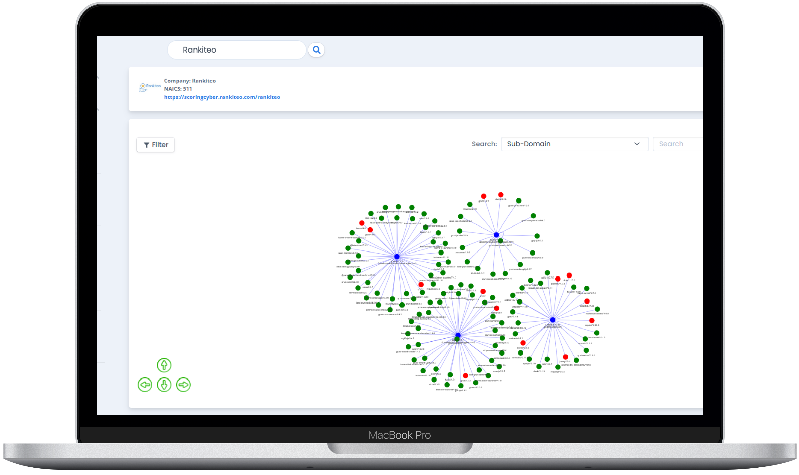
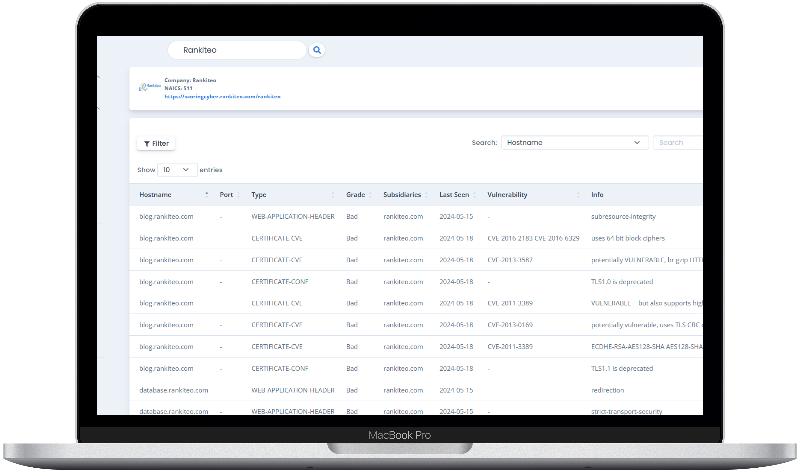
Identify exposed access points, detect misconfigured SSL certificates, and uncover vulnerabilities across the network infrastructure.
Gain visibility into the software components used within an organization to detect vulnerabilities, manage risk, and ensure supply chain security.
Monitor and manage all IT assets and their configurations to ensure accurate, real-time visibility across the company's technology environment.
Leverage real-time insights on active threats, malware campaigns, and emerging vulnerabilities to proactively defend against evolving cyberattacks.



 Rapid
Rapid