







NPM
Company Details
Linkedin ID:
national-palace-museum
Website:
Employees number:
122
Number of followers:
0
NAICS:
712
Industry Type:
Homepage:
npm.gov.tw
IP Addresses:
0
Company ID:
NAT_3531272
Scan Status:
In-progress


National Palace Museum Vendor Cyber Rating & Cyber Score
npm.gov.twFounding of the National Palace Museum The collection of cultural artifacts held by the National Palace Museum is composed of an enormous treasure trove of objects inherited from the previous Sung, Yüan, Ming and Ch'ing dynasties. When the Republic of China was first founded, these imperial treasures had remained within the Forbidden City with the last Ch'ing Emperor Pu Yi, but countless works of art were lost either because they were granted by Pu Yi as presents, because they were borrowed by his past noblemen, or because they were pledged to pawnbrokers or stolen. In 1914 the Republic of China Government relocated the cultural artifacts preserved at the Rehe Imperial Summer Retreat and the Shenyang Former Palace to the outer court of the Forbidden City, and made them available for public viewing at an Exhibition Office of Ancient Artifacts. In 1924 Pu Yi moved out of the Forbidden City, and the Government formed a "Committee for the Disposition of Ch'ing Imperial Possessions" to reorganize the invaluable artifacts stored within the Palace. On October 10, 1925 on National Day, the National Palace Museum was officially inaugurated to preserve the imperial collections and palatial treasures from the various Chinese dynasties, so that all members of the public and future generations will henceforth be able to freely enter the Palace to admire this cultural inheritance of humankind. During the first years of the National Palace Museum, a board of directors was set up as the decision-making and supervisory organ, which supervised over a subordinate board of executive directors, the two separate departments of Antiquities and Books, as well as the General Affairs Office. Over the years dramatic political changes ensued, and the National Palace Museum was in turn governed by the Maintenance Officer, Preservation Committee, Maintenance Committee and a Management Committee.
Company Details
national-palace-museum
122
0
712
npm.gov.tw
0
NAT_3531272
In-progress
 NPM Risk Score (AI oriented)
Between 800 and 849
 NPM Global Score (TPRM)
XXXX


No incidents recorded for National Palace Museum in 2026.
No incidents recorded for National Palace Museum in 2026.
No incidents recorded for National Palace Museum in 2026.
NPM cyber incidents detection timeline including parent company and subsidiaries

Founding of the National Palace Museum The collection of cultural artifacts held by the National Palace Museum is composed of an enormous treasure trove of objects inherited from the previous Sung, Yüan, Ming and Ch'ing dynasties. When the Republic of China was first founded, these imperial treasures had remained within the Forbidden City with the last Ch'ing Emperor Pu Yi, but countless works of art were lost either because they were granted by Pu Yi as presents, because they were borrowed by his past noblemen, or because they were pledged to pawnbrokers or stolen. In 1914 the Republic of China Government relocated the cultural artifacts preserved at the Rehe Imperial Summer Retreat and the Shenyang Former Palace to the outer court of the Forbidden City, and made them available for public viewing at an Exhibition Office of Ancient Artifacts. In 1924 Pu Yi moved out of the Forbidden City, and the Government formed a "Committee for the Disposition of Ch'ing Imperial Possessions" to reorganize the invaluable artifacts stored within the Palace. On October 10, 1925 on National Day, the National Palace Museum was officially inaugurated to preserve the imperial collections and palatial treasures from the various Chinese dynasties, so that all members of the public and future generations will henceforth be able to freely enter the Palace to admire this cultural inheritance of humankind. During the first years of the National Palace Museum, a board of directors was set up as the decision-making and supervisory organ, which supervised over a subordinate board of executive directors, the two separate departments of Antiquities and Books, as well as the General Affairs Office. Over the years dramatic political changes ensued, and the National Palace Museum was in turn governed by the Maintenance Officer, Preservation Committee, Maintenance Committee and a Management Committee.


➢ Midway Village Museum is an award-winning museum located just minutes off of Illinois I-90. A 148-acre museum campus, the setting offers a wonderful experience for visitors of all ages. ➢ As part of the museum campus, a Victorian-era Village is situated on 13 acres of the beautiful grounds whi

The Air Zoo is a highly charged, multi-sensory atmosphere that goes beyond anything you've ever seen. It's like no place else on Earth! From rare and historic to inspiring artwork and exhibits, there's always something new to discover at the Air Zoo. The Air Zoo is a world-class, Smithsonian-affili

Founded in 1825, the National Academy of Design promotes art and architecture in America through exhibition and instruction. As the leading honorary society for visual artists and architects in the United States, we advocate for the arts as a tool for education, celebrate the role of artists and arc

The Australian War Memorial combines a shrine, a world-class museum, and an extensive archive. The Memorial's purpose is to commemorate the sacrifice of those Australians who have died in war. Its mission is to assist Australians to remember, interpret and understand the Australian experience of war

The Historic Mitchelville Freedom Park [HMFP], Inc. is a non-profit South Carolina corporation which was formed: To preserve, promote and honor Historic Mitchelville, the first self-governed town of formerly enslaved people in the United States. On November 7, 1861, Union forces attacked two Confed

The UMLAUF Sculpture Garden + Museum provides educational experiences that encourage the understanding and appreciation of sculpture, and exhibits the work of Charles Umlauf and other contemporary sculptors in a natural setting. In 1985, Charles and Angeline Umlauf gave their home, studio, and 168

The Conservatory of Flowers is a Victorian wood and glass conservatory built in 1879. Our mission to connect people to plants in a place of exceptional beauty. Located in Golden Gate Park, we're open Thursday through Tuesday, from 10am to 4:30pm, for visitors to experience the rare exotic plants and
Founded in 1832, the Yale University Art Gallery is the oldest college art museum in America. Today, it is a center for teaching, learning, and scholarship and a preeminent cultural asset for Yale University, the wider academic community, and the public. The museum collects, preserves, studies, and
The Museum was developed through the efforts of the McAllen Junior League to increase the quality of life for the citizens of the Rio Grande Valley, and to provide activities in the arts and sciences that are meaningful, educational, and available to the public. The Museum was chartered under the
.png)
A billboard on a building near Gwanghwamun Square in Jongno District, central Seoul, displays an advertisement for BTS's comeback concert on...
Written by Isis M. Lee. A landmark exhibition in Prague displays 100 masterpieces from Taiwan's National Palace Museum — yet Taiwan itself...
The Musée du Louvre in Paris has been forced to close a public gallery and staff offices due to structural weaknesses. The museum announced...
An audit in 2014 found "serious shortcomings" in the Louvre's cybersecurity, including a two-decade-old software to manage its most critical...
The recent heist unfolded in broad daylight, when a four-member gang, disguised in construction vests and motorcycle helmets, used a cherry...
Investigators reveal Louvre heist security breach: museum cameras used the password 'Louvre', exposing major cyber vulnerability.
Cybersecurity experts revealed in 2014 that the Louvre museum's video surveillance system was protected by the password “Louvre.”
Thieves broke in through a second-floor window, but the museum has had other problems with unsecured Windows too, according to a decade-old...
In front of the Grünes Gewölbe, or 'Green Vault,' the palace-museum in Dresden, Germany, after the burglary on November 25, 2019.

Explore insights on cybersecurity incidents, risk posture, and Rankiteo's assessments.
The official website of National Palace Museum is http://www.npm.gov.tw.
According to Rankiteo, National Palace Museum’s AI-generated cybersecurity score is 832, reflecting their Good security posture.
According to Rankiteo, National Palace Museum currently holds 0 security badges, indicating that no recognized compliance certifications are currently verified for the organization.
According to Rankiteo, National Palace Museum has not been affected by any supply chain cyber incidents, and no incident IDs are currently listed for the organization.
According to Rankiteo, National Palace Museum is not certified under SOC 2 Type 1.
According to Rankiteo, National Palace Museum does not hold a SOC 2 Type 2 certification.
According to Rankiteo, National Palace Museum is not listed as GDPR compliant.
According to Rankiteo, National Palace Museum does not currently maintain PCI DSS compliance.
According to Rankiteo, National Palace Museum is not compliant with HIPAA regulations.
According to Rankiteo,National Palace Museum is not certified under ISO 27001, indicating the absence of a formally recognized information security management framework.
National Palace Museum operates primarily in the Museums, Historical Sites, and Zoos industry.
National Palace Museum employs approximately 122 people worldwide.
National Palace Museum presently has no subsidiaries across any sectors.
National Palace Museum’s official LinkedIn profile has approximately 0 followers.
National Palace Museum is classified under the NAICS code 712, which corresponds to Museums, Historical Sites, and Similar Institutions.
No, National Palace Museum does not have a profile on Crunchbase.
Yes, National Palace Museum maintains an official LinkedIn profile, which is actively utilized for branding and talent engagement, which can be accessed here: https://www.linkedin.com/company/national-palace-museum.
As of April 04, 2026, Rankiteo reports that National Palace Museum has not experienced any cybersecurity incidents.
National Palace Museum has an estimated 2,193 peer or competitor companies worldwide.
Total Incidents: According to Rankiteo, National Palace Museum has faced 0 incidents in the past.
Incident Types: The types of cybersecurity incidents that have occurred include .
.png)
Hirschmann EagleSDV version 05.4.01 prior to 05.4.02 contains a denial-of-service vulnerability that causes the device to crash during session establishment when using TLS 1.0 or TLS 1.1. Attackers can trigger a crash by initiating TLS connections with these protocol versions to disrupt service availability.
The stored API keys in temporary browser client is not marked as protected allowing for JavScript console or other errors to allow for extraction of the encryption credentials.
XSS vulnerability in cveInterface.js allows for inject HTML to be passed to display, as cveInterface trusts input from CVE API services
Multiple reflected cross-site scripting (XSS) vulnerabilities in the login.php endpoint of Interzen Consulting S.r.l ZenShare Suite v17.0 allows attackers to execute arbitrary Javascript in the context of the user's browser via a crafted URL injected into the codice_azienda and red_url parameters.
A reflected cross-site scripting (XSS) vulnerability in the login_newpwd.php endpoint of Interzen Consulting S.r.l ZenShare Suite v17.0 allows attackers to execute arbitrary Javascript in the context of the user's browser via a crafted URL injected into the codice_azienda parameter.

Get company history

Every week, Rankiteo analyzes billions of signals to give organizations a sharper, faster view of emerging risks. With deeper, more actionable intelligence at their fingertips, security teams can outpace threat actors, respond instantly to Zero-Day attacks, and dramatically shrink their risk exposure window.
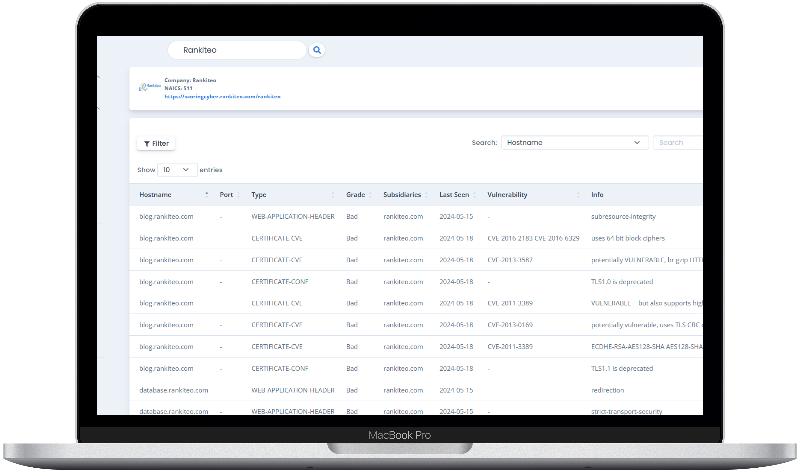
Identify exposed access points, detect misconfigured SSL certificates, and uncover vulnerabilities across the network infrastructure.
Gain visibility into the software components used within an organization to detect vulnerabilities, manage risk, and ensure supply chain security.
Monitor and manage all IT assets and their configurations to ensure accurate, real-time visibility across the company's technology environment.
Leverage real-time insights on active threats, malware campaigns, and emerging vulnerabilities to proactively defend against evolving cyberattacks.



 Rapid
Rapid