





MRM
Company Details
Linkedin ID:
mid-continent-railway-museum
Website:
Employees number:
8
Number of followers:
40
NAICS:
712
Industry Type:
Homepage:
midcontinent.org
IP Addresses:
0
Company ID:
MID_5364749
Scan Status:
In-progress


Mid-Continent Railway Museum Company CyberSecurity Posture
midcontinent.org


Mid-Continent Railway Historical Society–also known as Mid-Continent Railway Museum–is an outdoor, living museum and operating railroad recreating the small town/short line way of life during the “Golden Age of Railroading,” with operating trains, educational exhibits, and displays of restored rolling stock. Mid-Continent has operated at North Freedom, Wisconsin since 1963.
Company Details
mid-continent-railway-museum
8
40
712
midcontinent.org
0
MID_5364749
In-progress
 MRM Risk Score (AI oriented)
Between 750 and 799
 MRM Global Score (TPRM)
XXXX


No incidents recorded for Mid-Continent Railway Museum in 2026.
No incidents recorded for Mid-Continent Railway Museum in 2026.
No incidents recorded for Mid-Continent Railway Museum in 2026.
MRM cyber incidents detection timeline including parent company and subsidiaries

Mid-Continent Railway Historical Society–also known as Mid-Continent Railway Museum–is an outdoor, living museum and operating railroad recreating the small town/short line way of life during the “Golden Age of Railroading,” with operating trains, educational exhibits, and displays of restored rolling stock. Mid-Continent has operated at North Freedom, Wisconsin since 1963.


Liberty Hall Historic Site (LHHS) is a historic house museum with 2 homes (Liberty Hall, 1796 and the Orlando Brown House, 1835) on 4 acres of gardens on the banks of the Kentucky River. LHHS is located in downtown Frankfort, Kentucky and offers guided tours Mon-Sat at 1:30 pm from mid-March through

The mission of the International Women's Air & Space Museum is to collect, preserve, and showcase the history and culture of women in all areas of aviation & aerospace; educate people of the world about their contributions; and inspire future generations by bringing the history to life. The museum

Designed by the award-winning Zaha Hadid Architects, the Roca London Gallery is an innovative space where product display environments live harmoniously alongside a series of cultural exhibitions, events and meetings on a variety of themes such as architecture, design and sustainability. Roca Galle

The Federation of British Historic Vehicle Clubs exists to maintain our freedom to use Yesterday’s Vehicles on Tomorrow’s Roads. Additionally we encourage the preservation and promotion of all types of vehicle within the broader context of our national heritage. Our five-year strategy incorporate

We don't deliver the future, we help develop future viability. We work for and with our clients from business and industry, science and education, art and culture, to create experiential spaces and communication formats that address the big questions of the 21st century. With the expertise, creativi

Le musée du Louvre a notamment pour mission de conserver, protéger, restaurer et présenter au public les œuvres des collections inscrites sur ses inventaires comprises celles du musée national Eugène-Delacroix et des œuvres déposées dans le jardin des Tuileries ; d’assurer dans ces espaces l’accueil

Founded in 1832, the Yale University Art Gallery is the oldest college art museum in America. Today, it is a center for teaching, learning, and scholarship and a preeminent cultural asset for Yale University, the wider academic community, and the public. The museum collects, preserves, studies, and

Bainbridge Art Museum is a regional visual arts museum in the planning and design stages. We plan to open in fall 2012. We are an art museum devoted to the art and crafts of our region. We will host exhibits and education programs geared to all ages and interests. The museum will house a permane

Arts House Group (AHG) is a not-for-profit organisation dedicated to enriching lives through the transformative power of the arts. As a key part of Singapore’s arts and cultural landscape, AHG presents the nation’s two flagship festivals – the Singapore International Festival of Arts and the Singapo
.png)
ADIB hosted the UAE Cybersecurity Innovation Challenge, naming Corgea, Nothreat, and DTEX Systems as winners in a push for AI-driven and...
On December 30, Peter Levine, a Software Analyst at Evercore ISI, appeared on a CNBC interview to discuss the cybersecurity playbook for...
The European Commission has unveiled a new cybersecurity package aimed at reinforcing the European Union's (EU) resilience against growing...
International Seaways recently highlighted its cybersecurity focus as Global CISO Amit Basu presented at the 8th Annual Global Cyber Future...
Agentic AI operations are moving into production as organizations focus on observability, human oversight, and control of autonomous...
USF to offer new degree in cybersecurity. As more tech companies call the Tampa Bay area home and bring along a workforce pipeline,...
Kelley Information Technology outlines key cybersecurity actions every SMB executive in Central Florida should take to mitigate risks and...
The European Commission presented a revision of the Cybersecurity Act that introduces a phase-out of "high-risk suppliers" from critical...
AI agents' autonomy and wide access to data also exposes them to a new type of cybersecurity attack. It is also an opportunity for...

Explore insights on cybersecurity incidents, risk posture, and Rankiteo's assessments.
The official website of Mid-Continent Railway Museum is https://www.midcontinent.org.
According to Rankiteo, Mid-Continent Railway Museum’s AI-generated cybersecurity score is 766, reflecting their Fair security posture.
According to Rankiteo, Mid-Continent Railway Museum currently holds 0 security badges, indicating that no recognized compliance certifications are currently verified for the organization.
According to Rankiteo, Mid-Continent Railway Museum has not been affected by any supply chain cyber incidents, and no incident IDs are currently listed for the organization.
According to Rankiteo, Mid-Continent Railway Museum is not certified under SOC 2 Type 1.
According to Rankiteo, Mid-Continent Railway Museum does not hold a SOC 2 Type 2 certification.
According to Rankiteo, Mid-Continent Railway Museum is not listed as GDPR compliant.
According to Rankiteo, Mid-Continent Railway Museum does not currently maintain PCI DSS compliance.
According to Rankiteo, Mid-Continent Railway Museum is not compliant with HIPAA regulations.
According to Rankiteo,Mid-Continent Railway Museum is not certified under ISO 27001, indicating the absence of a formally recognized information security management framework.
Mid-Continent Railway Museum operates primarily in the Museums, Historical Sites, and Zoos industry.
Mid-Continent Railway Museum employs approximately 8 people worldwide.
Mid-Continent Railway Museum presently has no subsidiaries across any sectors.
Mid-Continent Railway Museum’s official LinkedIn profile has approximately 40 followers.
No, Mid-Continent Railway Museum does not have a profile on Crunchbase.
Yes, Mid-Continent Railway Museum maintains an official LinkedIn profile, which is actively utilized for branding and talent engagement, which can be accessed here: https://www.linkedin.com/company/mid-continent-railway-museum.
As of January 23, 2026, Rankiteo reports that Mid-Continent Railway Museum has not experienced any cybersecurity incidents.
Mid-Continent Railway Museum has an estimated 2,178 peer or competitor companies worldwide.
Total Incidents: According to Rankiteo, Mid-Continent Railway Museum has faced 0 incidents in the past.
Incident Types: The types of cybersecurity incidents that have occurred include .
.png)
Improper validation of specified type of input in M365 Copilot allows an unauthorized attacker to disclose information over a network.
Improper access control in Azure Front Door (AFD) allows an unauthorized attacker to elevate privileges over a network.
Azure Entra ID Elevation of Privilege Vulnerability
Moonraker is a Python web server providing API access to Klipper 3D printing firmware. In versions 0.9.3 and below, instances configured with the "ldap" component enabled are vulnerable to LDAP search filter injection techniques via the login endpoint. The 401 error response message can be used to determine whether or not a search was successful, allowing for brute force methods to discover LDAP entries on the server such as user IDs and user attributes. This issue has been fixed in version 0.10.0.
Runtipi is a Docker-based, personal homeserver orchestrator that facilitates multiple services on a single server. Versions 3.7.0 and above allow an authenticated user to execute arbitrary system commands on the host server by injecting shell metacharacters into backup filenames. The BackupManager fails to sanitize the filenames of uploaded backups. The system persists user-uploaded files directly to the host filesystem using the raw originalname provided in the request. This allows an attacker to stage a file containing shell metacharacters (e.g., $(id).tar.gz) at a predictable path, which is later referenced during the restore process. The successful storage of the file is what allows the subsequent restore command to reference and execute it. This issue has been fixed in version 4.7.0.

Get company history

Every week, Rankiteo analyzes billions of signals to give organizations a sharper, faster view of emerging risks. With deeper, more actionable intelligence at their fingertips, security teams can outpace threat actors, respond instantly to Zero-Day attacks, and dramatically shrink their risk exposure window.
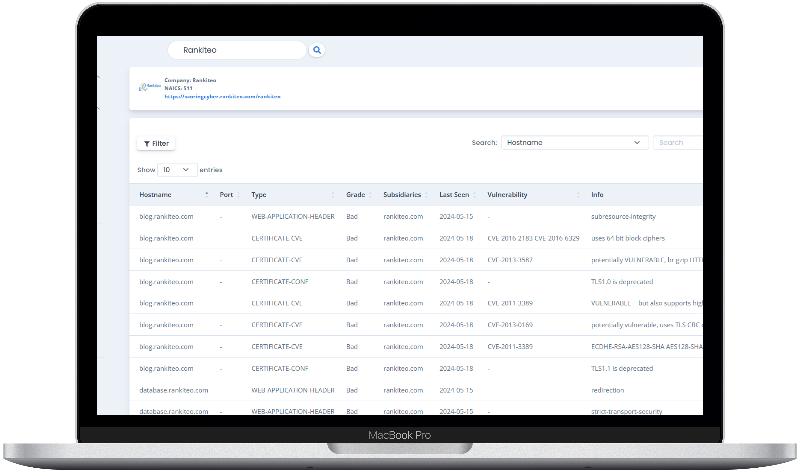
Identify exposed access points, detect misconfigured SSL certificates, and uncover vulnerabilities across the network infrastructure.
Gain visibility into the software components used within an organization to detect vulnerabilities, manage risk, and ensure supply chain security.
Monitor and manage all IT assets and their configurations to ensure accurate, real-time visibility across the company's technology environment.
Leverage real-time insights on active threats, malware campaigns, and emerging vulnerabilities to proactively defend against evolving cyberattacks.



 Rapid
Rapid