Company Details
jlugiessen
2,751
47,980
None
uni-giessen.de
212
JUS_5856466
Completed

Justus-Liebig-Universität Giessen Company CyberSecurity Posture
uni-giessen.deImpressum: https://www.uni-giessen.de/link-impres Datenschutzerklärung: https://www.uni-giessen.de/ueber-uns/datenschutz Willkommen bei der JLU! Exzellente Forschung, hervorragende Lehre, internationale Strahlkraft: Die Justus-Liebig-Universität Gießen hat viel zu bieten. Mit ca. 28.000 Studierenden ist die JLU die zweitgrößte Hochschule in Hessen, sie prägt die Region Mittelhessen entscheidend mit und profitiert von der Nähe zur Metropolregion Frankfurt/Rhein-Main. Moderne und Tradition ist für uns kein Gegensatz: Die JLU ist eine zukunftsorientierte Hochschule, die mit Stolz auf ihre über 400-jährige Geschichte zurückblickt. Sie wurde im Jahre 1607 gegründet und trägt heute den Namen eines ihrer berühmtesten Wissenschaftler: Justus Liebig, der in Gießen ab 1824 fast drei Jahrzehnte lang als Professor der Chemie forschte und lehrte. Liebig stellte im 19. Jahrhundert nicht nur die organische Chemie auf eine neue wissenschaftliche Grundlage, sondern führte zudem die systematische forschungsnahe und praxisbezogene Ausbildung von Studenten im Labor ein und verband Grundlagenforschung mit einer Vielzahl konkreter Anwendungsbereiche. Liebig vernetzte sich mit Kollegen in ganz Europa und leistete einen wesentlichen Beitrag zur internationalen Ausrichtung, die bis heute prägend für unsere Universität ist. In diesem Sinne steht der Name Justus-Liebig-Universität heute für anwendungsnahe („translationale“) Forschung auf höchstem Niveau, herausragende Nachwuchsförderung und internationale Vernetzung, insbesondere in den beiden Profilbereichen der JLU, den Lebens- und Kulturwissenschaften.
Company Details
jlugiessen
2,751
47,980
None
uni-giessen.de
212
JUS_5856466
Completed
Between 750 and 799

Justus-Liebig-Universität Giessen Global Score (TPRM)XXXX


No incidents recorded for Justus-Liebig-Universität Giessen in 2025.
Justus-Liebig-Universität Giessen cyber incidents detection timeline including parent company and subsidiaries

Impressum: https://www.uni-giessen.de/link-impres Datenschutzerklärung: https://www.uni-giessen.de/ueber-uns/datenschutz Willkommen bei der JLU! Exzellente Forschung, hervorragende Lehre, internationale Strahlkraft: Die Justus-Liebig-Universität Gießen hat viel zu bieten. Mit ca. 28.000 Studierenden ist die JLU die zweitgrößte Hochschule in Hessen, sie prägt die Region Mittelhessen entscheidend mit und profitiert von der Nähe zur Metropolregion Frankfurt/Rhein-Main. Moderne und Tradition ist für uns kein Gegensatz: Die JLU ist eine zukunftsorientierte Hochschule, die mit Stolz auf ihre über 400-jährige Geschichte zurückblickt. Sie wurde im Jahre 1607 gegründet und trägt heute den Namen eines ihrer berühmtesten Wissenschaftler: Justus Liebig, der in Gießen ab 1824 fast drei Jahrzehnte lang als Professor der Chemie forschte und lehrte. Liebig stellte im 19. Jahrhundert nicht nur die organische Chemie auf eine neue wissenschaftliche Grundlage, sondern führte zudem die systematische forschungsnahe und praxisbezogene Ausbildung von Studenten im Labor ein und verband Grundlagenforschung mit einer Vielzahl konkreter Anwendungsbereiche. Liebig vernetzte sich mit Kollegen in ganz Europa und leistete einen wesentlichen Beitrag zur internationalen Ausrichtung, die bis heute prägend für unsere Universität ist. In diesem Sinne steht der Name Justus-Liebig-Universität heute für anwendungsnahe („translationale“) Forschung auf höchstem Niveau, herausragende Nachwuchsförderung und internationale Vernetzung, insbesondere in den beiden Profilbereichen der JLU, den Lebens- und Kulturwissenschaften.


Sie ist eine von elf deutschen Exzellenzuniversitäten, die einzige Universität mit sechs Exzellenzclustern und hat in den vergangenen Jahrzehnten mehr Nobelpreise und Fields-Medaillen hervorgebracht als jede andere deutsche Hochschule – die Rheinische Friedrich-Wilhelms-Universität Bonn steht für we

Die Universität Luzern ist die jüngste Universität der Schweiz. Ihre Wurzeln reichen bis ins Jahr 1600 zurück, doch als moderne Hochschule besteht sie erst seit 2000. Die Universität Luzern besteht aus den vier Fakultäten für Theologie, für Kultur- und Sozialwissenschaften, für Rechtswissenschaft

Die Johannes Gutenberg-Universität Mainz (JGU) zählt mit rund 30.000 Studierenden aus 120 Nationen zu den größten und vielfältigsten Universitäten Deutschlands. Mit ihrer Universitätsmedizin, ihren Hochschulen für Kunst und Musik sowie ihrem Fachbereich Translations-, Sprach- und Kulturwissenschaft

Das LinkedIn-Profil aus der und rund um die Universität Duisburg-Essen Zu allen Links: https://uni-due.online/links/ Impressum: https://www.uni-due.de/de/impressum.shtml Netiquette: https.//www.uni-due.de/de/socialmedia/netiquette.php Offen im Denken: Inmitten der dichtesten Hochschullandschaft Eu

Die Humboldt-Universität zu Berlin (HU) ist Berlins älteste Universität. Mit knapp 35.000 Studierenden, rund 500 Professuren, mehr als 2.000 wissenschaftlichen Mitarbeiter*innen, zahlreichen Projekten der Spitzenforschung und in renommierten internationalen Netzwerken ist sie zugleich eine der bedeu

Culinary Arts Academy Switzerland is one of the world’s finest culinary schools. Blending tradition and technology, the academy serves up a top-rate culinary arts education, peppered with hands-on practice and seasoned with marketable, real-world business know-how. Transform a passion for food into
.png)
Students and staff at Justus Liebig University, also known as the University of Giessen, had to wait in line to recieve their new email passwords on paper.
After a cyber-attack at their university, 38000 students are asked to queue for a new email password.

Explore insights on cybersecurity incidents, risk posture, and Rankiteo's assessments.
The official website of Justus-Liebig-Universität Giessen is https://www.uni-giessen.de/.
According to Rankiteo, Justus-Liebig-Universität Giessen’s AI-generated cybersecurity score is 765, reflecting their Fair security posture.
According to Rankiteo, Justus-Liebig-Universität Giessen currently holds 0 security badges, indicating that no recognized compliance certifications are currently verified for the organization.
According to Rankiteo, Justus-Liebig-Universität Giessen is not certified under SOC 2 Type 1.
According to Rankiteo, Justus-Liebig-Universität Giessen does not hold a SOC 2 Type 2 certification.
According to Rankiteo, Justus-Liebig-Universität Giessen is not listed as GDPR compliant.
According to Rankiteo, Justus-Liebig-Universität Giessen does not currently maintain PCI DSS compliance.
According to Rankiteo, Justus-Liebig-Universität Giessen is not compliant with HIPAA regulations.
According to Rankiteo,Justus-Liebig-Universität Giessen is not certified under ISO 27001, indicating the absence of a formally recognized information security management framework.
Justus-Liebig-Universität Giessen operates primarily in the Hochschulen und Universitäten industry.
Justus-Liebig-Universität Giessen employs approximately 2,751 people worldwide.
Justus-Liebig-Universität Giessen presently has no subsidiaries across any sectors.
Justus-Liebig-Universität Giessen’s official LinkedIn profile has approximately 47,980 followers.
Justus-Liebig-Universität Giessen is classified under the NAICS code None, which corresponds to Others.
No, Justus-Liebig-Universität Giessen does not have a profile on Crunchbase.
Yes, Justus-Liebig-Universität Giessen maintains an official LinkedIn profile, which is actively utilized for branding and talent engagement, which can be accessed here: https://www.linkedin.com/company/jlugiessen.
As of December 18, 2025, Rankiteo reports that Justus-Liebig-Universität Giessen has not experienced any cybersecurity incidents.
Justus-Liebig-Universität Giessen has an estimated 101 peer or competitor companies worldwide.
Total Incidents: According to Rankiteo, Justus-Liebig-Universität Giessen has faced 0 incidents in the past.
Incident Types: The types of cybersecurity incidents that have occurred include .
.png)
Zerobyte is a backup automation tool Zerobyte versions prior to 0.18.5 and 0.19.0 contain an authentication bypass vulnerability where authentication middleware is not properly applied to API endpoints. This results in certain API endpoints being accessible without valid session credentials. This is dangerous for those who have exposed Zerobyte to be used outside of their internal network. A fix has been applied in both version 0.19.0 and 0.18.5. If immediate upgrade is not possible, restrict network access to the Zerobyte instance to trusted networks only using firewall rules or network segmentation. This is only a temporary mitigation; upgrading is strongly recommended.
Open Source Point of Sale (opensourcepos) is a web based point of sale application written in PHP using CodeIgniter framework. Starting in version 3.4.0 and prior to version 3.4.2, a Cross-Site Request Forgery (CSRF) vulnerability exists in the application's filter configuration. The CSRF protection mechanism was **explicitly disabled**, allowing the application to process state-changing requests (POST) without verifying a valid CSRF token. An unauthenticated remote attacker can exploit this by hosting a malicious web page. If a logged-in administrator visits this page, their browser is forced to send unauthorized requests to the application. A successful exploit allows the attacker to silently create a new Administrator account with full privileges, leading to a complete takeover of the system and loss of confidentiality, integrity, and availability. The vulnerability has been patched in version 3.4.2. The fix re-enables the CSRF filter in `app/Config/Filters.php` and resolves associated AJAX race conditions by adjusting token regeneration settings. As a workaround, administrators can manually re-enable the CSRF filter in `app/Config/Filters.php` by uncommenting the protection line. However, this is not recommended without applying the full patch, as it may cause functionality breakage in the Sales module due to token synchronization issues.
Zed, a code editor, has an aribtrary code execution vulnerability in versions prior to 0.218.2-pre. The Zed IDE loads Model Context Protocol (MCP) configurations from the `settings.json` file located within a project’s `.zed` subdirectory. A malicious MCP configuration can contain arbitrary shell commands that run on the host system with the privileges of the user running the IDE. This can be triggered automatically without any user interaction besides opening the project in the IDE. Version 0.218.2-pre fixes the issue by implementing worktree trust mechanism. As a workaround, users should carefully review the contents of project settings files (`./zed/settings.json`) before opening new projects in Zed.
Zed, a code editor, has an aribtrary code execution vulnerability in versions prior to 0.218.2-pre. The Zed IDE loads Language Server Protocol (LSP) configurations from the `settings.json` file located within a project’s `.zed` subdirectory. A malicious LSP configuration can contain arbitrary shell commands that run on the host system with the privileges of the user running the IDE. This can be triggered when a user opens project file for which there is an LSP entry. A concerted effort by an attacker to seed a project settings file (`./zed/settings.json`) with malicious language server configurations could result in arbitrary code execution with the user's privileges if the user opens the project in Zed without reviewing the contents. Version 0.218.2-pre fixes the issue by implementing worktree trust mechanism. As a workaround, users should carefully review the contents of project settings files (`./zed/settings.json`) before opening new projects in Zed.
Storybook is a frontend workshop for building user interface components and pages in isolation. A vulnerability present starting in versions 7.0.0 and prior to versions 7.6.21, 8.6.15, 9.1.17, and 10.1.10 relates to Storybook’s handling of environment variables defined in a `.env` file, which could, in specific circumstances, lead to those variables being unexpectedly bundled into the artifacts created by the `storybook build` command. When a built Storybook is published to the web, the bundle’s source is viewable, thus potentially exposing those variables to anyone with access. For a project to potentially be vulnerable to this issue, it must build the Storybook (i.e. run `storybook build` directly or indirectly) in a directory that contains a `.env` file (including variants like `.env.local`) and publish the built Storybook to the web. Storybooks built without a `.env` file at build time are not affected, including common CI-based builds where secrets are provided via platform environment variables rather than `.env` files. Storybook runtime environments (i.e. `storybook dev`) are not affected. Deployed applications that share a repo with your Storybook are not affected. Users should upgrade their Storybook—on both their local machines and CI environment—to version .6.21, 8.6.15, 9.1.17, or 10.1.10 as soon as possible. Maintainers additionally recommend that users audit for any sensitive secrets provided via `.env` files and rotate those keys. Some projects may have been relying on the undocumented behavior at the heart of this issue and will need to change how they reference environment variables after this update. If a project can no longer read necessary environmental variable values, either prefix the variables with `STORYBOOK_` or use the `env` property in Storybook’s configuration to manually specify values. In either case, do not include sensitive secrets as they will be included in the built bundle.

Get company history
Every week, Rankiteo analyzes billions of signals to give organizations a sharper, faster view of emerging risks. With deeper, more actionable intelligence at their fingertips, security teams can outpace threat actors, respond instantly to Zero-Day attacks, and dramatically shrink their risk exposure window.
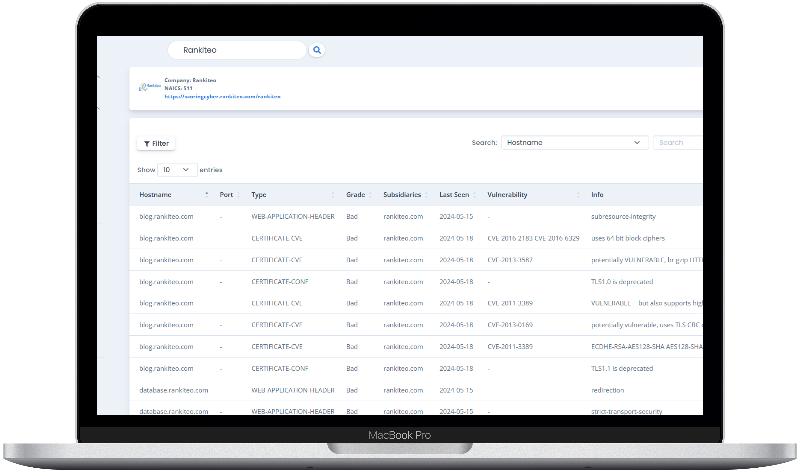
Identify exposed access points, detect misconfigured SSL certificates, and uncover vulnerabilities across the network infrastructure.
Gain visibility into the software components used within an organization to detect vulnerabilities, manage risk, and ensure supply chain security.
Monitor and manage all IT assets and their configurations to ensure accurate, real-time visibility across the company's technology environment.
Leverage real-time insights on active threats, malware campaigns, and emerging vulnerabilities to proactively defend against evolving cyberattacks.