





Hochschule Bremen
Company Details
Linkedin ID:
hochschule-bremen
Website:
Employees number:
987
Number of followers:
32,303
NAICS:
None
Industry Type:
Homepage:
hs-bremen.de
IP Addresses:
0
Company ID:
HOC_1695764
Scan Status:
In-progress

Hochschule Bremen Company CyberSecurity Posture
hs-bremen.de


Weltoffen, Wissenschaft für die Praxis: Mit mehr als 70 überwiegend internationalen Studiengängen und innovativen, lebensbegleitenden Studienformen bietet die HSB rund 8.700 Studierenden Perspektiven für ihre persönliche Entwicklung und einen erfolgreichen Karrierestart. Mit unserem internationalen Profil haben wir seit Jahrzehnten eine Spitzenstellung unter den Hochschulen. Mit ihrem Anwendungsbezug ist sie eine wichtige Partnerin für Unternehmen und Organisationen. Impressum: www.hs-bremen.de/impressum
Company Details
hochschule-bremen
987
32,303
None
hs-bremen.de
0
HOC_1695764
In-progress
 Hochschule Bremen Risk Score (AI oriented)
Between 750 and 799
 Hochschule Bremen Global Score (TPRM)
XXXX


No incidents recorded for Hochschule Bremen in 2025.
No incidents recorded for Hochschule Bremen in 2025.
No incidents recorded for Hochschule Bremen in 2025.
Hochschule Bremen cyber incidents detection timeline including parent company and subsidiaries

Weltoffen, Wissenschaft für die Praxis: Mit mehr als 70 überwiegend internationalen Studiengängen und innovativen, lebensbegleitenden Studienformen bietet die HSB rund 8.700 Studierenden Perspektiven für ihre persönliche Entwicklung und einen erfolgreichen Karrierestart. Mit unserem internationalen Profil haben wir seit Jahrzehnten eine Spitzenstellung unter den Hochschulen. Mit ihrem Anwendungsbezug ist sie eine wichtige Partnerin für Unternehmen und Organisationen. Impressum: www.hs-bremen.de/impressum


120.000 Studierende und Wissenschaftler studieren und forschen jährlich dank des Deutschen Akademischen Austauschdienstes e.V. im Ausland. Für diese internationale Zusammenarbeit und den akademischen Austausch engagieren sich weltweit 1.000 Mitarbeiter in Bonn, Berlin und 18 Außenstellen. Der DAAD u

From Archeology to Zoology, Physics to Psychology the University of Jena offers more than 190 programmes and main subjects. Alongside the obvious ‘big’ subjects and institutes, we have an interesting selection of ‘exotica’: Caucasology and South-East European Studies have Established themselves her

Die Goethe-Universität ist eine weltoffene Werkstatt der Zukunft mitten in Europa. Sie entstand 1914 als Gründung Frankfurter Bürger und knüpft seit 2008 als Stiftungsuniversität wieder an diese Tradition an: als autonome Bürger*innen-Universität eingebettet in die Stadtgesellschaft und mit einem ho

Die staatlich anerkannte PFH ist eine private Hochschule, die das unternehmerische Denken in den Mittelpunkt stellt. Sie bietet derzeit 55 Campus- und Fernstudiengänge in Management, Technologie, Healthcare Technology, Business Law, Wirtschaftsinformatik sowie Psychologie und Wirtschaftspsychologie

Die Universität des Saarlandes im Südwesten Deutschlands ist international bekannt durch ihre Spitzenforschung in der Informatik und in den Nano- und Lebenswissenschaften. Die engen Beziehungen zu Frankreich und der Europa-Schwerpunkt sind weitere Markenzeichen. Seit Juni 2020 ist die Universität Te

Mission of TU Graz • As a university located in the heart of Europe, TU Graz is committed to academic freedom and European core values as well as to a culture of acting in an ethical and responsible manner. • The university distinguishes itself through its internationally visible, forward-looking
.png)
After the rumor mill had been bubbling for weeks in advance, it became official at the end of July 2023: the European Commission announced...
We invited notable experts to share their insights and unbiased opinions on what we should expect from cybersecurity in the following year.
Experts at the European Cybersecurity Month warn that a common line of action is needed to address the increasingly complex cyberattacks...
The Russian invasion of Ukraine has sparked a surge of volunteer hackers, or hacktivists, battling on the digital frontline with Moscow.

Explore insights on cybersecurity incidents, risk posture, and Rankiteo's assessments.
The official website of Hochschule Bremen is https://www.hs-bremen.de/.
According to Rankiteo, Hochschule Bremen’s AI-generated cybersecurity score is 760, reflecting their Fair security posture.
According to Rankiteo, Hochschule Bremen currently holds 0 security badges, indicating that no recognized compliance certifications are currently verified for the organization.
According to Rankiteo, Hochschule Bremen is not certified under SOC 2 Type 1.
According to Rankiteo, Hochschule Bremen does not hold a SOC 2 Type 2 certification.
According to Rankiteo, Hochschule Bremen is not listed as GDPR compliant.
According to Rankiteo, Hochschule Bremen does not currently maintain PCI DSS compliance.
According to Rankiteo, Hochschule Bremen is not compliant with HIPAA regulations.
According to Rankiteo,Hochschule Bremen is not certified under ISO 27001, indicating the absence of a formally recognized information security management framework.
Hochschule Bremen operates primarily in the Hochschulen und Universitäten industry.
Hochschule Bremen employs approximately 987 people worldwide.
Hochschule Bremen presently has no subsidiaries across any sectors.
Hochschule Bremen’s official LinkedIn profile has approximately 32,303 followers.
Hochschule Bremen is classified under the NAICS code None, which corresponds to Others.
No, Hochschule Bremen does not have a profile on Crunchbase.
Yes, Hochschule Bremen maintains an official LinkedIn profile, which is actively utilized for branding and talent engagement, which can be accessed here: https://www.linkedin.com/company/hochschule-bremen.
As of December 18, 2025, Rankiteo reports that Hochschule Bremen has not experienced any cybersecurity incidents.
Hochschule Bremen has an estimated 101 peer or competitor companies worldwide.
Total Incidents: According to Rankiteo, Hochschule Bremen has faced 0 incidents in the past.
Incident Types: The types of cybersecurity incidents that have occurred include .
.png)
Zerobyte is a backup automation tool Zerobyte versions prior to 0.18.5 and 0.19.0 contain an authentication bypass vulnerability where authentication middleware is not properly applied to API endpoints. This results in certain API endpoints being accessible without valid session credentials. This is dangerous for those who have exposed Zerobyte to be used outside of their internal network. A fix has been applied in both version 0.19.0 and 0.18.5. If immediate upgrade is not possible, restrict network access to the Zerobyte instance to trusted networks only using firewall rules or network segmentation. This is only a temporary mitigation; upgrading is strongly recommended.
Open Source Point of Sale (opensourcepos) is a web based point of sale application written in PHP using CodeIgniter framework. Starting in version 3.4.0 and prior to version 3.4.2, a Cross-Site Request Forgery (CSRF) vulnerability exists in the application's filter configuration. The CSRF protection mechanism was **explicitly disabled**, allowing the application to process state-changing requests (POST) without verifying a valid CSRF token. An unauthenticated remote attacker can exploit this by hosting a malicious web page. If a logged-in administrator visits this page, their browser is forced to send unauthorized requests to the application. A successful exploit allows the attacker to silently create a new Administrator account with full privileges, leading to a complete takeover of the system and loss of confidentiality, integrity, and availability. The vulnerability has been patched in version 3.4.2. The fix re-enables the CSRF filter in `app/Config/Filters.php` and resolves associated AJAX race conditions by adjusting token regeneration settings. As a workaround, administrators can manually re-enable the CSRF filter in `app/Config/Filters.php` by uncommenting the protection line. However, this is not recommended without applying the full patch, as it may cause functionality breakage in the Sales module due to token synchronization issues.
Zed, a code editor, has an aribtrary code execution vulnerability in versions prior to 0.218.2-pre. The Zed IDE loads Model Context Protocol (MCP) configurations from the `settings.json` file located within a project’s `.zed` subdirectory. A malicious MCP configuration can contain arbitrary shell commands that run on the host system with the privileges of the user running the IDE. This can be triggered automatically without any user interaction besides opening the project in the IDE. Version 0.218.2-pre fixes the issue by implementing worktree trust mechanism. As a workaround, users should carefully review the contents of project settings files (`./zed/settings.json`) before opening new projects in Zed.
Zed, a code editor, has an aribtrary code execution vulnerability in versions prior to 0.218.2-pre. The Zed IDE loads Language Server Protocol (LSP) configurations from the `settings.json` file located within a project’s `.zed` subdirectory. A malicious LSP configuration can contain arbitrary shell commands that run on the host system with the privileges of the user running the IDE. This can be triggered when a user opens project file for which there is an LSP entry. A concerted effort by an attacker to seed a project settings file (`./zed/settings.json`) with malicious language server configurations could result in arbitrary code execution with the user's privileges if the user opens the project in Zed without reviewing the contents. Version 0.218.2-pre fixes the issue by implementing worktree trust mechanism. As a workaround, users should carefully review the contents of project settings files (`./zed/settings.json`) before opening new projects in Zed.
Storybook is a frontend workshop for building user interface components and pages in isolation. A vulnerability present starting in versions 7.0.0 and prior to versions 7.6.21, 8.6.15, 9.1.17, and 10.1.10 relates to Storybook’s handling of environment variables defined in a `.env` file, which could, in specific circumstances, lead to those variables being unexpectedly bundled into the artifacts created by the `storybook build` command. When a built Storybook is published to the web, the bundle’s source is viewable, thus potentially exposing those variables to anyone with access. For a project to potentially be vulnerable to this issue, it must build the Storybook (i.e. run `storybook build` directly or indirectly) in a directory that contains a `.env` file (including variants like `.env.local`) and publish the built Storybook to the web. Storybooks built without a `.env` file at build time are not affected, including common CI-based builds where secrets are provided via platform environment variables rather than `.env` files. Storybook runtime environments (i.e. `storybook dev`) are not affected. Deployed applications that share a repo with your Storybook are not affected. Users should upgrade their Storybook—on both their local machines and CI environment—to version .6.21, 8.6.15, 9.1.17, or 10.1.10 as soon as possible. Maintainers additionally recommend that users audit for any sensitive secrets provided via `.env` files and rotate those keys. Some projects may have been relying on the undocumented behavior at the heart of this issue and will need to change how they reference environment variables after this update. If a project can no longer read necessary environmental variable values, either prefix the variables with `STORYBOOK_` or use the `env` property in Storybook’s configuration to manually specify values. In either case, do not include sensitive secrets as they will be included in the built bundle.

Get company history

Every week, Rankiteo analyzes billions of signals to give organizations a sharper, faster view of emerging risks. With deeper, more actionable intelligence at their fingertips, security teams can outpace threat actors, respond instantly to Zero-Day attacks, and dramatically shrink their risk exposure window.
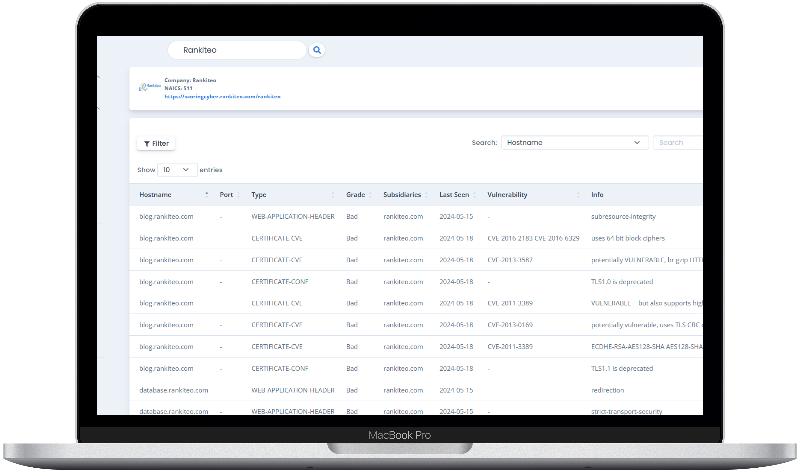
Identify exposed access points, detect misconfigured SSL certificates, and uncover vulnerabilities across the network infrastructure.
Gain visibility into the software components used within an organization to detect vulnerabilities, manage risk, and ensure supply chain security.
Monitor and manage all IT assets and their configurations to ensure accurate, real-time visibility across the company's technology environment.
Leverage real-time insights on active threats, malware campaigns, and emerging vulnerabilities to proactively defend against evolving cyberattacks.



 Rapid
Rapid