





WAWI
Company Details
Linkedin ID:
william-alanson-white-institute
Website:
Employees number:
118
Number of followers:
1,152
NAICS:
62133
Industry Type:
Homepage:
wawhite.org
IP Addresses:
0
Company ID:
WIL_1797679
Scan Status:
In-progress


William Alanson White Institute Company CyberSecurity Posture
wawhite.org


The William Alanson White Institute of Psychiatry, Psychoanalysis & Psychology has distinguished itself as one of the world's most prominent and respected psychoanalytic training and treatment centers for more than eighty years. Our faculty and graduates make major contributions to the professional literature and to assume significant leadership roles in academic and clinical training settings and in national and international professional organizations.
Company Details
william-alanson-white-institute
118
1,152
62133
wawhite.org
0
WIL_1797679
In-progress
 WAWI Risk Score (AI oriented)
Between 750 and 799
 WAWI Global Score (TPRM)
XXXX


No incidents recorded for William Alanson White Institute in 2026.
No incidents recorded for William Alanson White Institute in 2026.
No incidents recorded for William Alanson White Institute in 2026.
WAWI cyber incidents detection timeline including parent company and subsidiaries

The William Alanson White Institute of Psychiatry, Psychoanalysis & Psychology has distinguished itself as one of the world's most prominent and respected psychoanalytic training and treatment centers for more than eighty years. Our faculty and graduates make major contributions to the professional literature and to assume significant leadership roles in academic and clinical training settings and in national and international professional organizations.


Intermountain is a visionary non-profit agency that has been impacting the lives of children and families in Montana for over 100 years. With holistic, integrated services and a relationship-based approach, we help families create and sustain nurturing, healthy environments where children can thrive

Thriving Minds Behavioral Health offers expert assessment and intervention for childhood developmental and learning issues. We specialize in anxiety, including Selective Mutism, social anxiety, Obsessive Compulsive Disorder, generalized anxiety, and specific phobias. Thriving Minds Behavioral Healt

Center for Mentalisering har til formål at udbrede viden om mentalisering og at udbrede mentaliseringsbaseret behandling i arbejdet med udsatte børn, unge og voksne. Centret tilbyder en række ydelser (supervision & terapi, efteruddannelse & kursusdage), der tager afsæt i en mentaliseringsbaseret

Likewise supports people experiencing mental health problems, social exclusion and isolation. We know that we’re all equally human and being there for each other really matters. We think the most important thing is that people have places and relationships where they feel safe to be themselves. P

Interact Behavior Consulting (IBC) provides services to children with autism and other developmental disabilities in the San Francisco Bay Area and East Bay regions of Northern California. Our company is committed to creating individualized programs for each child that are based on the principle

Eugene Therapy provides counseling and mental health services in Eugene, Oregon. We also have offices in Corvallis, Bend, Portland and via telehealth throughout Oregon (Oregon Counseling). We provide services for the treatment of anxiety, depression, trauma, eating disorders, relationship and a host

We are a community of advocates and activists that make change happen. We are hosted by United for Global Mental Health and work in partnership with the World Health Organization, UNICEF and over 2,000 national and local organisations from around the world. Joining the Action Network connects you

The Pavilion Behavioral Health System has been the leading provider of behavioral health and addictions treatment for families in Illinois since 1989. Located in Champaign, Illinois, we provide a secure, nurturing environment where children, adolescents, adults and senior adults can find hope and he

Quality Behavioral Health Services provides mental health services in collaboration with clinical staff members of your facility, and with other providers, including physicians, nurse practitioners, physical and occupational therapists. Providing in-house psychological services will help minimize ex
.png)
The European Commission's proposal to revise the EU Cybersecurity Act has drawn support from industry figures, who say the changes recognise...
Port Sudan – Sudanhorizon. The Ministry of Digital Transformation and Communications on Thursday announced the official launching of thre...
India News: With traditional security models unable to control AI-powered cyberattacks, 63SATS Cybertech, part of 63 moons technologies,...
The construction industry faces unique cybersecurity challenges that distinguish it from other sectors. With complex payment structures,...
Before new technology reaches the warfighter, a team within the Air Force Office of Special Investigations evaluates the cyber risks behind...
Palo Alto Networks and Microsoft are two leading security companies that protect their clients and generate value for shareholders.
SCAM ALERT — Learn practical skills to protect yourself from fraud with program at the Canton Library.
Despite industry hype around autonomous defence, new research shows security teams spent 2025 using AI mainly to explain and contextualise...
Concerned about the orgs that safeguard your money? The UK's annual cybersecurity review for 2025 suggests you should be.

Explore insights on cybersecurity incidents, risk posture, and Rankiteo's assessments.
The official website of William Alanson White Institute is http://www.wawhite.org.
According to Rankiteo, William Alanson White Institute’s AI-generated cybersecurity score is 755, reflecting their Fair security posture.
According to Rankiteo, William Alanson White Institute currently holds 0 security badges, indicating that no recognized compliance certifications are currently verified for the organization.
According to Rankiteo, William Alanson White Institute has not been affected by any supply chain cyber incidents, and no incident IDs are currently listed for the organization.
According to Rankiteo, William Alanson White Institute is not certified under SOC 2 Type 1.
According to Rankiteo, William Alanson White Institute does not hold a SOC 2 Type 2 certification.
According to Rankiteo, William Alanson White Institute is not listed as GDPR compliant.
According to Rankiteo, William Alanson White Institute does not currently maintain PCI DSS compliance.
According to Rankiteo, William Alanson White Institute is not compliant with HIPAA regulations.
According to Rankiteo,William Alanson White Institute is not certified under ISO 27001, indicating the absence of a formally recognized information security management framework.
William Alanson White Institute operates primarily in the Mental Health Care industry.
William Alanson White Institute employs approximately 118 people worldwide.
William Alanson White Institute presently has no subsidiaries across any sectors.
William Alanson White Institute’s official LinkedIn profile has approximately 1,152 followers.
William Alanson White Institute is classified under the NAICS code 62133, which corresponds to Offices of Mental Health Practitioners (except Physicians).
No, William Alanson White Institute does not have a profile on Crunchbase.
Yes, William Alanson White Institute maintains an official LinkedIn profile, which is actively utilized for branding and talent engagement, which can be accessed here: https://www.linkedin.com/company/william-alanson-white-institute.
As of January 22, 2026, Rankiteo reports that William Alanson White Institute has not experienced any cybersecurity incidents.
William Alanson White Institute has an estimated 5,276 peer or competitor companies worldwide.
Total Incidents: According to Rankiteo, William Alanson White Institute has faced 0 incidents in the past.
Incident Types: The types of cybersecurity incidents that have occurred include .
.png)
Backstage is an open framework for building developer portals, and @backstage/backend-defaults provides the default implementations and setup for a standard Backstage backend app. Prior to versions 0.12.2, 0.13.2, 0.14.1, and 0.15.0, the `FetchUrlReader` component, used by the catalog and other plugins to fetch content from URLs, followed HTTP redirects automatically. This allowed an attacker who controls a host listed in `backend.reading.allow` to redirect requests to internal or sensitive URLs that are not on the allowlist, bypassing the URL allowlist security control. This is a Server-Side Request Forgery (SSRF) vulnerability that could allow access to internal resources, but it does not allow attackers to include additional request headers. This vulnerability is fixed in `@backstage/backend-defaults` version 0.12.2, 0.13.2, 0.14.1, and 0.15.0. Users should upgrade to this version or later. Some workarounds are available. Restrict `backend.reading.allow` to only trusted hosts that you control and that do not issue redirects, ensure allowed hosts do not have open redirect vulnerabilities, and/or use network-level controls to block access from Backstage to sensitive internal endpoints.
Backstage is an open framework for building developer portals, and @backstage/cli-common provides config loading functionality used by the backend and command line interface of Backstage. Prior to version 0.1.17, the `resolveSafeChildPath` utility function in `@backstage/backend-plugin-api`, which is used to prevent path traversal attacks, failed to properly validate symlink chains and dangling symlinks. An attacker could bypass the path validation via symlink chains (creating `link1 → link2 → /outside` where intermediate symlinks eventually resolve outside the allowed directory) and dangling symlinks (creating symlinks pointing to non-existent paths outside the base directory, which would later be created during file operations). This function is used by Scaffolder actions and other backend components to ensure file operations stay within designated directories. This vulnerability is fixed in `@backstage/backend-plugin-api` version 0.1.17. Users should upgrade to this version or later. Some workarounds are available. Run Backstage in a containerized environment with limited filesystem access and/or restrict template creation to trusted users.
Backstage is an open framework for building developer portals. Multiple Scaffolder actions and archive extraction utilities were vulnerable to symlink-based path traversal attacks. An attacker with access to create and execute Scaffolder templates could exploit symlinks to read arbitrary files via the `debug:log` action by creating a symlink pointing to sensitive files (e.g., `/etc/passwd`, configuration files, secrets); delete arbitrary files via the `fs:delete` action by creating symlinks pointing outside the workspace, and write files outside the workspace via archive extraction (tar/zip) containing malicious symlinks. This affects any Backstage deployment where users can create or execute Scaffolder templates. This vulnerability is fixed in `@backstage/backend-defaults` versions 0.12.2, 0.13.2, 0.14.1, and 0.15.0; `@backstage/plugin-scaffolder-backend` versions 2.2.2, 3.0.2, and 3.1.1; and `@backstage/plugin-scaffolder-node` versions 0.11.2 and 0.12.3. Users should upgrade to these versions or later. Some workarounds are available. Follow the recommendation in the Backstage Threat Model to limit access to creating and updating templates, restrict who can create and execute Scaffolder templates using the permissions framework, audit existing templates for symlink usage, and/or run Backstage in a containerized environment with limited filesystem access.
FastAPI Api Key provides a backend-agnostic library that provides an API key system. Version 1.1.0 has a timing side-channel vulnerability in verify_key(). The method applied a random delay only on verification failures, allowing an attacker to statistically distinguish valid from invalid API keys by measuring response latencies. With enough repeated requests, an adversary could infer whether a key_id corresponds to a valid key, potentially accelerating brute-force or enumeration attacks. All users relying on verify_key() for API key authentication prior to the fix are affected. Users should upgrade to version 1.1.0 to receive a patch. The patch applies a uniform random delay (min_delay to max_delay) to all responses regardless of outcome, eliminating the timing correlation. Some workarounds are available. Add an application-level fixed delay or random jitter to all authentication responses (success and failure) before the fix is applied and/or use rate limiting to reduce the feasibility of statistical timing attacks.
The Flux Operator is a Kubernetes CRD controller that manages the lifecycle of CNCF Flux CD and the ControlPlane enterprise distribution. Starting in version 0.36.0 and prior to version 0.40.0, a privilege escalation vulnerability exists in the Flux Operator Web UI authentication code that allows an attacker to bypass Kubernetes RBAC impersonation and execute API requests with the operator's service account privileges. In order to be vulnerable, cluster admins must configure the Flux Operator with an OIDC provider that issues tokens lacking the expected claims (e.g., `email`, `groups`), or configure custom CEL expressions that can evaluate to empty values. After OIDC token claims are processed through CEL expressions, there is no validation that the resulting `username` and `groups` values are non-empty. When both values are empty, the Kubernetes client-go library does not add impersonation headers to API requests, causing them to be executed with the flux-operator service account's credentials instead of the authenticated user's limited permissions. This can result in privilege escalation, data exposure, and/or information disclosure. Version 0.40.0 patches the issue.
Get company history

Every week, Rankiteo analyzes billions of signals to give organizations a sharper, faster view of emerging risks. With deeper, more actionable intelligence at their fingertips, security teams can outpace threat actors, respond instantly to Zero-Day attacks, and dramatically shrink their risk exposure window.
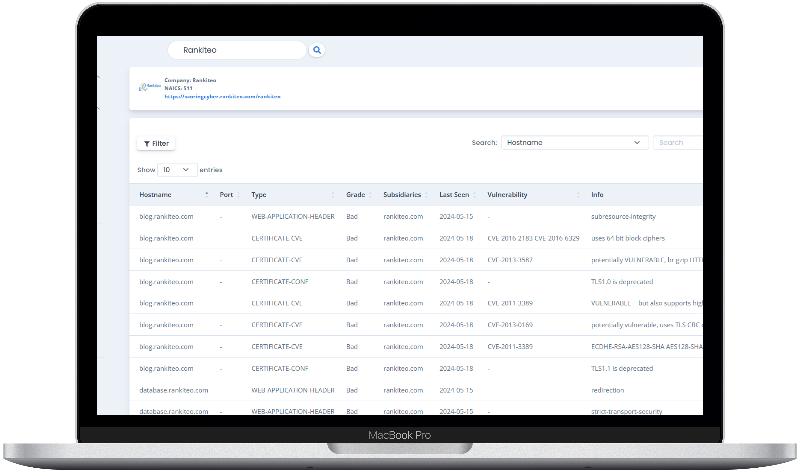
Identify exposed access points, detect misconfigured SSL certificates, and uncover vulnerabilities across the network infrastructure.
Gain visibility into the software components used within an organization to detect vulnerabilities, manage risk, and ensure supply chain security.
Monitor and manage all IT assets and their configurations to ensure accurate, real-time visibility across the company's technology environment.
Leverage real-time insights on active threats, malware campaigns, and emerging vulnerabilities to proactively defend against evolving cyberattacks.



 Rapid
Rapid