





EC
Company Details
Linkedin ID:
the-enrichment-center-al
Employees number:
74
Number of followers:
80
NAICS:
621
Industry Type:
Homepage:
theenrichmentcenter.org
IP Addresses:
0
Company ID:
THE_4729007
Scan Status:
In-progress


The Enrichment Center Company CyberSecurity Posture
theenrichmentcenter.org


The Enrichment Center is a 501(c)3 non-profit located in Madison, AL. Founded in 2002 by Dr. Larry Little, The Enrichment Center's focus was on providing quality mental health and relationship counseling to the surrounding community. In 2006 The Enrichment Center became the home to the Enrich & Impact Program (E&I), a prevention and intervention counseling program for students in the schools of our surrounding communities. E&I was specifically designed to meet the needs of students who are suffering and have little or no real access to professional counseling services. The Enrich & Impact plan, program, and curriculum were developed by The Enrichment Center based on a needs assessment from area Children’s Policy Council including representatives from local school systems, juvenile court, mental health providers, and healthcare providers which outlined a need to provide effective prevention services for students at-risk. Because no student should go without quality mental health counseling, students and their families do not pay for Enrich & Impact services and The Enrichment Center does not bill insurance for reimbursement of services either. We truly are completely not-for-profit, relying the community to help meet the needs of our students & their families. There is currently not another comparable program to Enrich & Impact in the North Alabama area. Our vision is to have a dedicated E&I counselor in every school in North Alabama. Our mission is to make a difference in the lives of students, their families, and their schools. We are a relationship-driven organization. Our core values are Trust, Investment, & Growth. We believe that by establishing trust and passionately investing in our students we can help them grow into healthy and productive young adults.
Company Details
the-enrichment-center-al
74
80
621
theenrichmentcenter.org
0
THE_4729007
In-progress
 EC Risk Score (AI oriented)
Between 750 and 799
 EC Global Score (TPRM)
XXXX


No incidents recorded for The Enrichment Center in 2026.
No incidents recorded for The Enrichment Center in 2026.
No incidents recorded for The Enrichment Center in 2026.
EC cyber incidents detection timeline including parent company and subsidiaries

The Enrichment Center is a 501(c)3 non-profit located in Madison, AL. Founded in 2002 by Dr. Larry Little, The Enrichment Center's focus was on providing quality mental health and relationship counseling to the surrounding community. In 2006 The Enrichment Center became the home to the Enrich & Impact Program (E&I), a prevention and intervention counseling program for students in the schools of our surrounding communities. E&I was specifically designed to meet the needs of students who are suffering and have little or no real access to professional counseling services. The Enrich & Impact plan, program, and curriculum were developed by The Enrichment Center based on a needs assessment from area Children’s Policy Council including representatives from local school systems, juvenile court, mental health providers, and healthcare providers which outlined a need to provide effective prevention services for students at-risk. Because no student should go without quality mental health counseling, students and their families do not pay for Enrich & Impact services and The Enrichment Center does not bill insurance for reimbursement of services either. We truly are completely not-for-profit, relying the community to help meet the needs of our students & their families. There is currently not another comparable program to Enrich & Impact in the North Alabama area. Our vision is to have a dedicated E&I counselor in every school in North Alabama. Our mission is to make a difference in the lives of students, their families, and their schools. We are a relationship-driven organization. Our core values are Trust, Investment, & Growth. We believe that by establishing trust and passionately investing in our students we can help them grow into healthy and productive young adults.


Our Mission is to empower individuals and families living with mental health and substance abuse concerns by providing counseling, Care Coordination, and supportive services. We focus on individual strengths to foster the achievement of personal goals and healthy decisions. We do this because we val

Doug Smith, author of “The Trauma Code” & “Thriving in Transition”, is a thought leader on the impact of workplace induced emotional trauma. An accomplished keynote speaker & communicator, Doug presents a trauma management model he developed (System438) to address trauma and maximize human performan

Advent Group Ministries is a faith-motivated, non-profit, social-service agency providing addiction recovery services and counseling to people of all ages and income levels since 1985. Our mission is to empower people to restore relationships and break the destructive cycles of abuse and addiction t

Psychologist with private practice for 16 years (individual, couples, families, group). Psychodramatist. Script & Hosting. Topics on sexuality, depression, anorexia, couples problems, etc.

Our Trust provides mental health, learning disability and specialist children’s services across South Staffordshire and mental health and learning disability services in Shropshire, Telford & Wrekin and Powys. We also provide some services on a wider regional, or national basis. We aim to be posi

Sunshine Coast Health Centre uses a Meaning-Centered Treatment Model that integrates non-12 Step, research-based practices such as medical, psychiatric, psychosocial, and positive existential psychotherapy. We focus on addiction as a lack of personal meaning rather than a disease. Our focus on perso

Our mission is to assist individuals with emotional, behavioral, mental health challenges, and addictive diseases. We are a supportive team that provides professional guidance for individuals, while providing an opportunity to make positive changes in their lives. Furthermore, our agency strengthens

Autism Response Team was founded 18 years ago by Dr Ali Sadeghi and Dr Leili Zarbakhsh. Dr Ali Sadeghi was a phenomenal clinical psychologist, whom brought the approach of overall family care to ABA. The idea is to focus on the care and support for the full family unit in order to ensure long term s

Multisystemic Therapy (MST) is a scientifically proven intervention for at-risk youth. Therapists work in the home, school, and community and are on call 24/7 to provide caregivers with the tools they need to transform the lives of troubled youth. Research demonstrates that MST reduces criminal acti
.png)
The University of Houston has been redesignated by the National Security Agency (NSA) as a Center for Academic Excellence in Cyber Research...
Embry‑Riddle Aeronautical University has been awarded a $1.85 million Cyber Service Academy grant from the U.S. Department of Defense (DoD)...
ELKHART, Ind., October 1, 2025 (Newswire.com) - ITR Concession Company LLC (ITRCC), the concessionaire and operator of the Indiana Toll Road...
In a new document, the US Cybersecurity and Infrastructure Security Agency (CISA) has confirmed its support for the Common Vulnerabilities...
Nuclear company General Matter announced Tuesday it will build a $1.5 billion uranium enrichment facility at the site of the Energy...
Cybersecurity journalist Kim Zetter, testifying before Congress, described Stuxnet as the first cyberattack to move beyond digital...
Indicators of Compromise (IoCs) are digital clues that help identify malicious activity in an endpoint or network.
Analysts say pro-Iranian hackers have not gravely impacted U.S. infrastructure but that could change if the ceasefire with Israel fails.
With support from the NSM Graduate Student Conference Travel Award, Ph.D. student Yang Lu earns international recognition for advancing...

Explore insights on cybersecurity incidents, risk posture, and Rankiteo's assessments.
The official website of The Enrichment Center is http://www.theenrichmentcenter.org.
According to Rankiteo, The Enrichment Center’s AI-generated cybersecurity score is 760, reflecting their Fair security posture.
According to Rankiteo, The Enrichment Center currently holds 0 security badges, indicating that no recognized compliance certifications are currently verified for the organization.
According to Rankiteo, The Enrichment Center has not been affected by any supply chain cyber incidents, and no incident IDs are currently listed for the organization.
According to Rankiteo, The Enrichment Center is not certified under SOC 2 Type 1.
According to Rankiteo, The Enrichment Center does not hold a SOC 2 Type 2 certification.
According to Rankiteo, The Enrichment Center is not listed as GDPR compliant.
According to Rankiteo, The Enrichment Center does not currently maintain PCI DSS compliance.
According to Rankiteo, The Enrichment Center is not compliant with HIPAA regulations.
According to Rankiteo,The Enrichment Center is not certified under ISO 27001, indicating the absence of a formally recognized information security management framework.
The Enrichment Center operates primarily in the Mental Health Care industry.
The Enrichment Center employs approximately 74 people worldwide.
The Enrichment Center presently has no subsidiaries across any sectors.
The Enrichment Center’s official LinkedIn profile has approximately 80 followers.
No, The Enrichment Center does not have a profile on Crunchbase.
Yes, The Enrichment Center maintains an official LinkedIn profile, which is actively utilized for branding and talent engagement, which can be accessed here: https://www.linkedin.com/company/the-enrichment-center-al.
As of January 22, 2026, Rankiteo reports that The Enrichment Center has not experienced any cybersecurity incidents.
The Enrichment Center has an estimated 5,276 peer or competitor companies worldwide.
Total Incidents: According to Rankiteo, The Enrichment Center has faced 0 incidents in the past.
Incident Types: The types of cybersecurity incidents that have occurred include .
.png)
Backstage is an open framework for building developer portals, and @backstage/backend-defaults provides the default implementations and setup for a standard Backstage backend app. Prior to versions 0.12.2, 0.13.2, 0.14.1, and 0.15.0, the `FetchUrlReader` component, used by the catalog and other plugins to fetch content from URLs, followed HTTP redirects automatically. This allowed an attacker who controls a host listed in `backend.reading.allow` to redirect requests to internal or sensitive URLs that are not on the allowlist, bypassing the URL allowlist security control. This is a Server-Side Request Forgery (SSRF) vulnerability that could allow access to internal resources, but it does not allow attackers to include additional request headers. This vulnerability is fixed in `@backstage/backend-defaults` version 0.12.2, 0.13.2, 0.14.1, and 0.15.0. Users should upgrade to this version or later. Some workarounds are available. Restrict `backend.reading.allow` to only trusted hosts that you control and that do not issue redirects, ensure allowed hosts do not have open redirect vulnerabilities, and/or use network-level controls to block access from Backstage to sensitive internal endpoints.
Backstage is an open framework for building developer portals, and @backstage/cli-common provides config loading functionality used by the backend and command line interface of Backstage. Prior to version 0.1.17, the `resolveSafeChildPath` utility function in `@backstage/backend-plugin-api`, which is used to prevent path traversal attacks, failed to properly validate symlink chains and dangling symlinks. An attacker could bypass the path validation via symlink chains (creating `link1 → link2 → /outside` where intermediate symlinks eventually resolve outside the allowed directory) and dangling symlinks (creating symlinks pointing to non-existent paths outside the base directory, which would later be created during file operations). This function is used by Scaffolder actions and other backend components to ensure file operations stay within designated directories. This vulnerability is fixed in `@backstage/backend-plugin-api` version 0.1.17. Users should upgrade to this version or later. Some workarounds are available. Run Backstage in a containerized environment with limited filesystem access and/or restrict template creation to trusted users.
Backstage is an open framework for building developer portals. Multiple Scaffolder actions and archive extraction utilities were vulnerable to symlink-based path traversal attacks. An attacker with access to create and execute Scaffolder templates could exploit symlinks to read arbitrary files via the `debug:log` action by creating a symlink pointing to sensitive files (e.g., `/etc/passwd`, configuration files, secrets); delete arbitrary files via the `fs:delete` action by creating symlinks pointing outside the workspace, and write files outside the workspace via archive extraction (tar/zip) containing malicious symlinks. This affects any Backstage deployment where users can create or execute Scaffolder templates. This vulnerability is fixed in `@backstage/backend-defaults` versions 0.12.2, 0.13.2, 0.14.1, and 0.15.0; `@backstage/plugin-scaffolder-backend` versions 2.2.2, 3.0.2, and 3.1.1; and `@backstage/plugin-scaffolder-node` versions 0.11.2 and 0.12.3. Users should upgrade to these versions or later. Some workarounds are available. Follow the recommendation in the Backstage Threat Model to limit access to creating and updating templates, restrict who can create and execute Scaffolder templates using the permissions framework, audit existing templates for symlink usage, and/or run Backstage in a containerized environment with limited filesystem access.
FastAPI Api Key provides a backend-agnostic library that provides an API key system. Version 1.1.0 has a timing side-channel vulnerability in verify_key(). The method applied a random delay only on verification failures, allowing an attacker to statistically distinguish valid from invalid API keys by measuring response latencies. With enough repeated requests, an adversary could infer whether a key_id corresponds to a valid key, potentially accelerating brute-force or enumeration attacks. All users relying on verify_key() for API key authentication prior to the fix are affected. Users should upgrade to version 1.1.0 to receive a patch. The patch applies a uniform random delay (min_delay to max_delay) to all responses regardless of outcome, eliminating the timing correlation. Some workarounds are available. Add an application-level fixed delay or random jitter to all authentication responses (success and failure) before the fix is applied and/or use rate limiting to reduce the feasibility of statistical timing attacks.
The Flux Operator is a Kubernetes CRD controller that manages the lifecycle of CNCF Flux CD and the ControlPlane enterprise distribution. Starting in version 0.36.0 and prior to version 0.40.0, a privilege escalation vulnerability exists in the Flux Operator Web UI authentication code that allows an attacker to bypass Kubernetes RBAC impersonation and execute API requests with the operator's service account privileges. In order to be vulnerable, cluster admins must configure the Flux Operator with an OIDC provider that issues tokens lacking the expected claims (e.g., `email`, `groups`), or configure custom CEL expressions that can evaluate to empty values. After OIDC token claims are processed through CEL expressions, there is no validation that the resulting `username` and `groups` values are non-empty. When both values are empty, the Kubernetes client-go library does not add impersonation headers to API requests, causing them to be executed with the flux-operator service account's credentials instead of the authenticated user's limited permissions. This can result in privilege escalation, data exposure, and/or information disclosure. Version 0.40.0 patches the issue.

Get company history

Every week, Rankiteo analyzes billions of signals to give organizations a sharper, faster view of emerging risks. With deeper, more actionable intelligence at their fingertips, security teams can outpace threat actors, respond instantly to Zero-Day attacks, and dramatically shrink their risk exposure window.
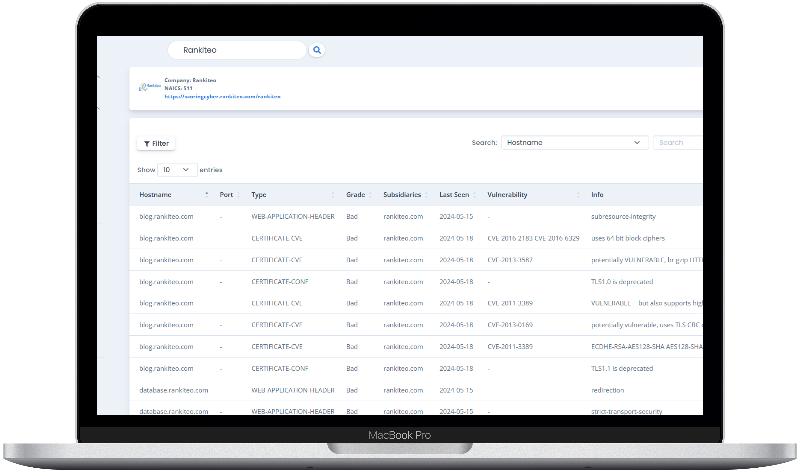
Identify exposed access points, detect misconfigured SSL certificates, and uncover vulnerabilities across the network infrastructure.
Gain visibility into the software components used within an organization to detect vulnerabilities, manage risk, and ensure supply chain security.
Monitor and manage all IT assets and their configurations to ensure accurate, real-time visibility across the company's technology environment.
Leverage real-time insights on active threats, malware campaigns, and emerging vulnerabilities to proactively defend against evolving cyberattacks.



 Rapid
Rapid