





The DoSeum
Company Details
Linkedin ID:
the-doseum
Website:
Employees number:
56
Number of followers:
2,498
NAICS:
712
Industry Type:
Homepage:
thedoseum.org
IP Addresses:
0
Company ID:
THE_2460996
Scan Status:
In-progress

The DoSeum Company CyberSecurity Posture
thedoseum.org


The DoSeum is much more than a children’s museum - it’s a place where interactive fun and hands-on learning come together—a place where minds are always at play. The DoSeum offers exhibits, programs, camps, classes, and field trips designed for all learners, encouraging young minds to explore the joy of learning through connections to STEM, the arts, and literacy. Originally founded as San Antonio Children’s Museum in 1995, The DoSeum has grown to become a premier leader in informal education, while still staying true to the mission of connecting families and transforming communities. As a 501(c)(3), The DoSeum is committed to accessible and free programming to low-income San Antonio-area children, with a goal of serving 10,000 kids from Title I schools annually. At 68,000 square feet of interactive exhibit space, The DoSeum’s wow-worthy facility, opened in 2015, inspires each Guest to cultivate their curiosity, ignite learning, and discover the power of play.
Company Details
the-doseum
56
2,498
712
thedoseum.org
0
THE_2460996
In-progress
 The DoSeum Risk Score (AI oriented)
Between 750 and 799
 The DoSeum Global Score (TPRM)
XXXX


No incidents recorded for The DoSeum in 2026.
No incidents recorded for The DoSeum in 2026.
No incidents recorded for The DoSeum in 2026.
The DoSeum cyber incidents detection timeline including parent company and subsidiaries

The DoSeum is much more than a children’s museum - it’s a place where interactive fun and hands-on learning come together—a place where minds are always at play. The DoSeum offers exhibits, programs, camps, classes, and field trips designed for all learners, encouraging young minds to explore the joy of learning through connections to STEM, the arts, and literacy. Originally founded as San Antonio Children’s Museum in 1995, The DoSeum has grown to become a premier leader in informal education, while still staying true to the mission of connecting families and transforming communities. As a 501(c)(3), The DoSeum is committed to accessible and free programming to low-income San Antonio-area children, with a goal of serving 10,000 kids from Title I schools annually. At 68,000 square feet of interactive exhibit space, The DoSeum’s wow-worthy facility, opened in 2015, inspires each Guest to cultivate their curiosity, ignite learning, and discover the power of play.


La Residencia de Estudiantes es en la actualidad una fundación, creada por el Consejo Superior de Investigaciones Científicas (CSIC), de cuyo Patronato forman parte, además del CSIC, el Ministerio de Asuntos Exteriores y de Cooperación, el Ministerio de Industria, Turismo y Comercio, el Ministerio d

Sealcentre Pieterburen is a science-based hospital and research centre for mainly Harbour and Grey seals. We believe in healthy seals, as bio-indicators for a healthy sea. We work as a learning community, in which volunteers, student, visitors, partners and the general public are all involved. Toget

Amazement Square is Central Virginia's first multidisciplinary, hands-on children's museum! Climb, slide and discover as you make your way through four floors of exciting, interactive exhibits, activities and programs. Visitors of all ages, backgrounds and abilities can explore global and regiona

Acting on the principle that learning is a joy, the Children’s Museum of Phoenix’s mission is to engage the minds, muscles and imaginations of children and the grown-ups who care about them. With hands-on, interactive exhibits designed for children ages birth to 10, the Museum focuses on learning th

The Delaware Museum of Natural History is now the Delaware Museum of Nature & Science. We have embarked on the most ambitious and significant capital campaign since our doors opened to the public in 1972. Our goal is a complete reinvention—a metamorphosis—to meet the community need for a regional le

The mission of the CAF Airpower Museum is to tell the complete story of World War II military aviation by collecting, preserving, and interpreting World War II material culture. The Museum serves a broad and diverse audience by preserving the memory of the men and women who built, supported, and fle

The mission of The Mark Twain House & Museum is to foster an appreciation of the legacy of Mark Twain as one of our nation’s defining cultural figures, and to demonstrate the continuing relevance of his work, life and times. The Mark Twain House & Museum has restored the author’s Hartford, Connec

Thank you for visiting our page! The Nantucket Maria Mitchell Association is a private non-profit organization located on the island of Nantucket, Massachusetts. The Maria Mitchell Association (MMA) was founded in 1902 to preserve the legacy of Nantucket native astronomer, naturalist, librarian,

One of Pittsburgh’s oldest and best known historical landmarks, Soldiers & Sailors Memorial Hall & Museum is the nation’s only military museum dedicated to honoring the men and women of all branches of service, and in all capacities (Active, Reserve, Guard). The historic building was designed by ren
.png)
The opening of the revamped exhibit coincides with the fifth anniversary of the DoSeum's Broadway location.

Explore insights on cybersecurity incidents, risk posture, and Rankiteo's assessments.
The official website of The DoSeum is http://www.thedoseum.org/.
According to Rankiteo, The DoSeum’s AI-generated cybersecurity score is 762, reflecting their Fair security posture.
According to Rankiteo, The DoSeum currently holds 0 security badges, indicating that no recognized compliance certifications are currently verified for the organization.
According to Rankiteo, The DoSeum has not been affected by any supply chain cyber incidents, and no incident IDs are currently listed for the organization.
According to Rankiteo, The DoSeum is not certified under SOC 2 Type 1.
According to Rankiteo, The DoSeum does not hold a SOC 2 Type 2 certification.
According to Rankiteo, The DoSeum is not listed as GDPR compliant.
According to Rankiteo, The DoSeum does not currently maintain PCI DSS compliance.
According to Rankiteo, The DoSeum is not compliant with HIPAA regulations.
According to Rankiteo,The DoSeum is not certified under ISO 27001, indicating the absence of a formally recognized information security management framework.
The DoSeum operates primarily in the Museums, Historical Sites, and Zoos industry.
The DoSeum employs approximately 56 people worldwide.
The DoSeum presently has no subsidiaries across any sectors.
The DoSeum’s official LinkedIn profile has approximately 2,498 followers.
No, The DoSeum does not have a profile on Crunchbase.
Yes, The DoSeum maintains an official LinkedIn profile, which is actively utilized for branding and talent engagement, which can be accessed here: https://www.linkedin.com/company/the-doseum.
As of January 24, 2026, Rankiteo reports that The DoSeum has not experienced any cybersecurity incidents.
The DoSeum has an estimated 2,180 peer or competitor companies worldwide.
Total Incidents: According to Rankiteo, The DoSeum has faced 0 incidents in the past.
Incident Types: The types of cybersecurity incidents that have occurred include .
.png)
Typemill is a flat-file, Markdown-based CMS designed for informational documentation websites. A reflected Cross-Site Scripting (XSS) exists in the login error view template `login.twig` of versions 2.19.1 and below. The `username` value can be echoed back without proper contextual encoding when authentication fails. An attacker can execute script in the login page context. This issue has been fixed in version 2.19.2.
A DOM-based Cross-Site Scripting (XSS) vulnerability exists in the DomainCheckerApp class within domain/script.js of Sourcecodester Domain Availability Checker v1.0. The vulnerability occurs because the application improperly handles user-supplied data in the createResultElement method by using the unsafe innerHTML property to render domain search results.
A Remote Code Execution (RCE) vulnerability exists in Sourcecodester Modern Image Gallery App v1.0 within the gallery/upload.php component. The application fails to properly validate uploaded file contents. Additionally, the application preserves the user-supplied file extension during the save process. This allows an unauthenticated attacker to upload arbitrary PHP code by spoofing the MIME type as an image, leading to full system compromise.
A UNIX symbolic link following issue in the jailer component in Firecracker version v1.13.1 and earlier and 1.14.0 on Linux may allow a local host user with write access to the pre-created jailer directories to overwrite arbitrary host files via a symlink attack during the initialization copy at jailer startup, if the jailer is executed with root privileges. To mitigate this issue, users should upgrade to version v1.13.2 or 1.14.1 or above.
An information disclosure vulnerability exists in the /srvs/membersrv/getCashiers endpoint of the Aptsys gemscms backend platform thru 2025-05-28. This unauthenticated endpoint returns a list of cashier accounts, including names, email addresses, usernames, and passwords hashed using MD5. As MD5 is a broken cryptographic function, the hashes can be easily reversed using public tools, exposing user credentials in plaintext. This allows remote attackers to perform unauthorized logins and potentially gain access to sensitive POS operations or backend functions.

Get company history

Every week, Rankiteo analyzes billions of signals to give organizations a sharper, faster view of emerging risks. With deeper, more actionable intelligence at their fingertips, security teams can outpace threat actors, respond instantly to Zero-Day attacks, and dramatically shrink their risk exposure window.
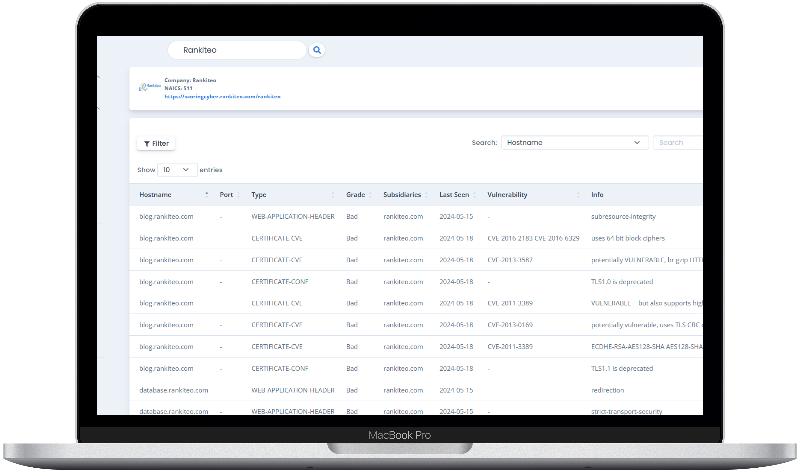
Identify exposed access points, detect misconfigured SSL certificates, and uncover vulnerabilities across the network infrastructure.
Gain visibility into the software components used within an organization to detect vulnerabilities, manage risk, and ensure supply chain security.
Monitor and manage all IT assets and their configurations to ensure accurate, real-time visibility across the company's technology environment.
Leverage real-time insights on active threats, malware campaigns, and emerging vulnerabilities to proactively defend against evolving cyberattacks.



 Rapid
Rapid