







HLGSM
Company Details
Linkedin ID:
hhl-leipzig-graduate-school-of-management
Website:
Employees number:
286
Number of followers:
20,174
NAICS:
None
Industry Type:
Homepage:
hhl.de
IP Addresses:
0
Company ID:
HHL_3297270
Scan Status:
In-progress


HHL Leipzig Graduate School of Management Vendor Cyber Rating & Cyber Score
hhl.deMission & Vision: “We educate entrepreneurial, responsible and effective business leaders through outstanding teaching, research and practice. We are driven by excellence in teaching and research to benefit our students, stakeholders and society. Our academic quality is underscored by our global outlook and a lifelong premier service and support network.” To achieve our mission, we build on entrepreneurship and leadership, two pillars grown with HHL’s history of leading change and transformation. While entrepreneurship enables transformation, leadership is relevant to lead transformation. HHL Leipzig Graduate School of Management is a university-level institution and ranks amongst the leading international business schools. The goal of the oldest business school in German-speaking Europe is to educate entrepreneurial, responsible and effective business leaders. HHL stands out for its excellent teaching, its clear research focus, its effective knowledge transfer into practice as well as its outstanding student services. Study programs include a Master in Management program, with possible specializations in Entrepreneurship or Finance, as well as an MBA program. Programs can be completed full-time or part-time. HHL also runs a Doctoral Program. The HHL Executive Education offers state-of-the-art management seminars for executive talents. Besides its main campus in Leipzig, the university maintains study locations in Cologne and Munich. HHL is accredited by AACSB International and ACQUIN. •#2 worldwide for Alumni Network – full-time MSc (Financial Times Global Masters in Management Ranking 2023) •#17 worldwide for Return on Investment – full-time MBA (QS Global MBA Ranking 2024) •#1 Entrepreneurial University in Germany (Startup Radar by Stifterverband für die Deutsche Wissenschaft 2022) Master & MBA programs: hhl.de/programs/master-programs/ Executive Education: hhl.de/programs/executive-education/ Imprint HHL: hhl.de/imprint/ Privacy Policy: hhl.de/privacy/
Company Details
hhl-leipzig-graduate-school-of-management
286
20,174
None
hhl.de
0
HHL_3297270
In-progress
 HLGSM Risk Score (AI oriented)
Between 750 and 799
 HLGSM Global Score (TPRM)
XXXX


No incidents recorded for HHL Leipzig Graduate School of Management in 2026.
No incidents recorded for HHL Leipzig Graduate School of Management in 2026.
No incidents recorded for HHL Leipzig Graduate School of Management in 2026.
HLGSM cyber incidents detection timeline including parent company and subsidiaries

Mission & Vision: “We educate entrepreneurial, responsible and effective business leaders through outstanding teaching, research and practice. We are driven by excellence in teaching and research to benefit our students, stakeholders and society. Our academic quality is underscored by our global outlook and a lifelong premier service and support network.” To achieve our mission, we build on entrepreneurship and leadership, two pillars grown with HHL’s history of leading change and transformation. While entrepreneurship enables transformation, leadership is relevant to lead transformation. HHL Leipzig Graduate School of Management is a university-level institution and ranks amongst the leading international business schools. The goal of the oldest business school in German-speaking Europe is to educate entrepreneurial, responsible and effective business leaders. HHL stands out for its excellent teaching, its clear research focus, its effective knowledge transfer into practice as well as its outstanding student services. Study programs include a Master in Management program, with possible specializations in Entrepreneurship or Finance, as well as an MBA program. Programs can be completed full-time or part-time. HHL also runs a Doctoral Program. The HHL Executive Education offers state-of-the-art management seminars for executive talents. Besides its main campus in Leipzig, the university maintains study locations in Cologne and Munich. HHL is accredited by AACSB International and ACQUIN. •#2 worldwide for Alumni Network – full-time MSc (Financial Times Global Masters in Management Ranking 2023) •#17 worldwide for Return on Investment – full-time MBA (QS Global MBA Ranking 2024) •#1 Entrepreneurial University in Germany (Startup Radar by Stifterverband für die Deutsche Wissenschaft 2022) Master & MBA programs: hhl.de/programs/master-programs/ Executive Education: hhl.de/programs/executive-education/ Imprint HHL: hhl.de/imprint/ Privacy Policy: hhl.de/privacy/


I created "My own company" in order to be able to invoice my clients, but I am now fully retired. I spend a fair share of my leisure time enhancing my "hobby" website (https://anglais-pratique.fr/), which is primarily intended for French speakers who wish to improve their English. I want to leave th

L'AFPA, PREMIER ORGANISME DE FORMATION PROFESSIONNELLE DES ADULTES Avec plus de 140 000 personnes formées chaque année dans plus de 200 implantations partout en France, l’Afpa, devenue Agence nationale pour la formation professionnelle des adultes en janvier 2017, est depuis plus de 65 ans, le pr
.png)
Harvard is monitoring an ongoing cybersecurity threat involving individuals impersonating University information technology staff to gain...
This week in cybersecurity: a prankish trojan, C2 via Spotify, a $53m DEX hack, and an EU data breach. 04.04.2026 ForkLog.
Infostealers (malware specifically designed to steal sensitive information) have become one of the most dangerous cybersecurity threats and...
The South Asian Business Council of Virginia (SABCVA) celebrated the graduation of participants from its AI and Cybersecurity Internship...
Sometimes tech policy feels like an endless parade of grandiose promises worth billions that vanish into thin air after just two days.
Microsoft commits 1.6 trillion yen to Japan for AI infrastructure and cybersecurity, aiming to train 1 million engineers by 2030 in...
Japan's Financial Services Agency (FSA) has issued guidelines aimed at strengthening cybersecurity at virtual asset (cryptocurrency)...
Three-year coordinated collaboration aims to automate incident detection, response, certification, and secure updates.
A LinkedIn post from Cyberhaven highlights an intensive schedule of recent field marketing and community engagement activities across...

Explore insights on cybersecurity incidents, risk posture, and Rankiteo's assessments.
The official website of HHL Leipzig Graduate School of Management is https://www.hhl.de/.
According to Rankiteo, HHL Leipzig Graduate School of Management’s AI-generated cybersecurity score is 756, reflecting their Fair security posture.
According to Rankiteo, HHL Leipzig Graduate School of Management currently holds 0 security badges, indicating that no recognized compliance certifications are currently verified for the organization.
According to Rankiteo, HHL Leipzig Graduate School of Management has not been affected by any supply chain cyber incidents, and no incident IDs are currently listed for the organization.
According to Rankiteo, HHL Leipzig Graduate School of Management is not certified under SOC 2 Type 1.
According to Rankiteo, HHL Leipzig Graduate School of Management does not hold a SOC 2 Type 2 certification.
According to Rankiteo, HHL Leipzig Graduate School of Management is not listed as GDPR compliant.
According to Rankiteo, HHL Leipzig Graduate School of Management does not currently maintain PCI DSS compliance.
According to Rankiteo, HHL Leipzig Graduate School of Management is not compliant with HIPAA regulations.
According to Rankiteo,HHL Leipzig Graduate School of Management is not certified under ISO 27001, indicating the absence of a formally recognized information security management framework.
HHL Leipzig Graduate School of Management operates primarily in the Hochschulen und Universitäten industry.
HHL Leipzig Graduate School of Management employs approximately 286 people worldwide.
HHL Leipzig Graduate School of Management presently has no subsidiaries across any sectors.
HHL Leipzig Graduate School of Management’s official LinkedIn profile has approximately 20,174 followers.
No, HHL Leipzig Graduate School of Management does not have a profile on Crunchbase.
Yes, HHL Leipzig Graduate School of Management maintains an official LinkedIn profile, which is actively utilized for branding and talent engagement, which can be accessed here: https://www.linkedin.com/company/hhl-leipzig-graduate-school-of-management.
As of April 04, 2026, Rankiteo reports that HHL Leipzig Graduate School of Management has not experienced any cybersecurity incidents.
HHL Leipzig Graduate School of Management has an estimated 25 peer or competitor companies worldwide.
Total Incidents: According to Rankiteo, HHL Leipzig Graduate School of Management has faced 0 incidents in the past.
Incident Types: The types of cybersecurity incidents that have occurred include .
.png)
nimiq/core-rs-albatross is a Rust implementation of the Nimiq Proof-of-Stake protocol based on the Albatross consensus algorithm. Prior to version 1.3.0, two peer-facing consensus request handlers assume that the history index is always available and call blockchain.history_store.history_index().unwrap() directly. That assumption is false by construction. HistoryStoreProxy::history_index() explicitly returns None for the valid HistoryStoreProxy::WithoutIndex state. when a full node is syncing or otherwise running without the history index, a remote peer can send RequestTransactionsProof or RequestTransactionReceiptsByAddress and trigger an Option::unwrap() panic on the request path. This issue has been patched in version 1.3.0.
PraisonAI is a multi-agent teams system. Prior to version 1.5.95, FileTools.download_file() in praisonaiagents validates the destination path but performs no validation on the url parameter, passing it directly to httpx.stream() with follow_redirects=True. An attacker who controls the URL can reach any host accessible from the server including cloud metadata services and internal network services. This issue has been patched in version 1.5.95.
PraisonAI is a multi-agent teams system. Prior to version 4.5.97, OAuthManager.validate_token() returns True for any token not found in its internal store, which is empty by default. Any HTTP request to the MCP server with an arbitrary Bearer token is treated as authenticated, granting full access to all registered tools and agent capabilities. This issue has been patched in version 4.5.97.
PraisonAI is a multi-agent teams system. Prior to version 4.5.97, the PraisonAI Gateway server accepts WebSocket connections at /ws and serves agent topology at /info with no authentication. Any network client can connect, enumerate registered agents, and send arbitrary messages to agents and their tool sets. This issue has been patched in version 4.5.97.
PraisonAI is a multi-agent teams system. Prior to version 4.5.90, MCPToolIndex.search_tools() compiles a caller-supplied string directly as a Python regular expression with no validation, sanitization, or timeout. A crafted regex causes catastrophic backtracking in the re engine, blocking the Python thread for hundreds of seconds and causing a complete service outage. This issue has been patched in version 4.5.90.

Get company history

Every week, Rankiteo analyzes billions of signals to give organizations a sharper, faster view of emerging risks. With deeper, more actionable intelligence at their fingertips, security teams can outpace threat actors, respond instantly to Zero-Day attacks, and dramatically shrink their risk exposure window.
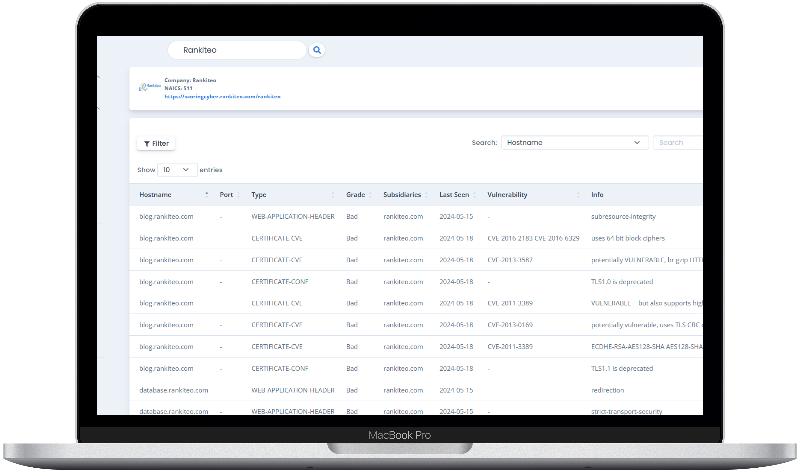
Identify exposed access points, detect misconfigured SSL certificates, and uncover vulnerabilities across the network infrastructure.
Gain visibility into the software components used within an organization to detect vulnerabilities, manage risk, and ensure supply chain security.
Monitor and manage all IT assets and their configurations to ensure accurate, real-time visibility across the company's technology environment.
Leverage real-time insights on active threats, malware campaigns, and emerging vulnerabilities to proactively defend against evolving cyberattacks.



 Rapid
Rapid