





WN
Company Details
Linkedin ID:
the-wren's-nest
Website:
Employees number:
42
Number of followers:
313
NAICS:
712
Industry Type:
Homepage:
wrensnest.org
IP Addresses:
0
Company ID:
THE_3104539
Scan Status:
In-progress

The Wren's Nest Company CyberSecurity Posture
wrensnest.org


The Wren’s Nest, the historic home of author and journalist Joel Chandler Harris, is a cultural center, house museum, and National Historic Landmark in Atlanta's West End neighborhood. Our mission is to preserve storytelling traditions, cultivate the next generation of readers and writers, and celebrate self-expression through educational and cultural programming, including house tours, live storytelling performances, free book programs, youth writing programs, and special events.
Company Details
the-wren's-nest
42
313
712
wrensnest.org
0
THE_3104539
In-progress
 WN Risk Score (AI oriented)
Between 750 and 799
 WN Global Score (TPRM)
XXXX


No incidents recorded for The Wren's Nest in 2026.
No incidents recorded for The Wren's Nest in 2026.
No incidents recorded for The Wren's Nest in 2026.
WN cyber incidents detection timeline including parent company and subsidiaries
The Wren’s Nest, the historic home of author and journalist Joel Chandler Harris, is a cultural center, house museum, and National Historic Landmark in Atlanta's West End neighborhood. Our mission is to preserve storytelling traditions, cultivate the next generation of readers and writers, and celebrate self-expression through educational and cultural programming, including house tours, live storytelling performances, free book programs, youth writing programs, and special events.


The story of Bellefontaine Cemetery, a non-sectarian, perpetual care cemetery, begins with the year 1849, when many prominent citizens of St. Louis, who had the welfare of the City at heart, recognized that the old cemeteries located along Jefferson Avenue would soon have to be abandoned, since they

Pinhead Institute is a Smithsonian Affiliate based in Telluride, Colorado, that strives to promote science-education both locally & globally. An international network of the world's leading scientists supports our many educational programs providing unparalleled opportunity to high-level scientific
The Morris Museum of Art was founded in 1985 and opened to the public in 1992. It is the oldest museum in the country that is devoted to the art and artists of the American South. The museum’s permanent collection holds more than six thousand works of art that date from the late-eighteenth century t

In a region noted for its spirit of innovation and global influence, contemporary art is valued for enriching and revealing our shared humanity. The ICA San José champions artists and cultivates engagement with contemporary art through thought-provoking exhibitions and programs. The ICA has long be

The Old Bridgewater Historical Society was founded in 1894 and incorporated in 1895 for the purposes of promoting education and research relating to the original township of Bridgewater, its inhabitants, and its history by collecting, preserving, exhibiting, and interpreting materials, artifacts, an

The Heurich House Museum’s mission is to explore the American Experience through the legacy of German immigrant Christian Heurich and his Washington, DC brewery, and to create a just path to success for local small-scale manufacturers. The museum works to reinvent the traditional historic house muse

The Florida Aquarium actively participates in and promotes stewardship of the natural environment as part of our mission of conservation. As a 501(c)(3) not-for-profit organization, The Florida Aquarium provides an opportunity to see over 8,000 aquatic and terrestrial animals, explore complex ecosys

The NAS was formed to further interest in our underwater cultural heritage. We are dedicated to advancing education in nautical archaeology at all levels from the general public to professionals in the sector. To this end we: run an accredited training programme, publish a peer-reviewed journal; org

Strawbery Banke Museum, in the heart of historic downtown Portsmouth, New Hampshire, is an authentic 10-acre outdoor history museum dedicated to bringing 300+ years of American history in the same waterfront neighborhood to life. The Museum is a place for children, adults, multigenerational families
.png)
Western Alliance Bancorporation recently appointed Stephen McMaster as Chief Information Security Officer, tasking him with leading...
Cybersecurity narratives this week converged on a single reality: digital risk has fully migrated into the executive and institutional...
The European Commission this week presented its proposed revision of the Cybersecurity Act, as part of a cybersecurity package.
Tanium has shared an update. The company is hosting a webinar on January 27 featuring a Forrester senior analyst and a Tanium executive to...
Miami, Florida, January 22nd, 2026, CyberNewsWire. Halo Security, a leading provider of external attack surface management and penetration...
A Texas-based telecommunications giant is building out a Charlotte cybersecurity office, with dozens of employees already hired.
The ETF applies a covered call mechanism on HACK holdings, with monthly distributions tied to option premiums.
The trillion-dollar biopharma is balancing innovation with caution.
A 9.8-severity flaw (CVE-2026-24061) in GNU InetUtils telnetd allows remote authentication bypass and root access in versions 1.9.3 to 2.7.

Explore insights on cybersecurity incidents, risk posture, and Rankiteo's assessments.
The official website of The Wren's Nest is http://www.wrensnest.org.
According to Rankiteo, The Wren's Nest’s AI-generated cybersecurity score is 764, reflecting their Fair security posture.
According to Rankiteo, The Wren's Nest currently holds 0 security badges, indicating that no recognized compliance certifications are currently verified for the organization.
According to Rankiteo, The Wren's Nest has not been affected by any supply chain cyber incidents, and no incident IDs are currently listed for the organization.
According to Rankiteo, The Wren's Nest is not certified under SOC 2 Type 1.
According to Rankiteo, The Wren's Nest does not hold a SOC 2 Type 2 certification.
According to Rankiteo, The Wren's Nest is not listed as GDPR compliant.
According to Rankiteo, The Wren's Nest does not currently maintain PCI DSS compliance.
According to Rankiteo, The Wren's Nest is not compliant with HIPAA regulations.
According to Rankiteo,The Wren's Nest is not certified under ISO 27001, indicating the absence of a formally recognized information security management framework.
The Wren's Nest operates primarily in the Museums, Historical Sites, and Zoos industry.
The Wren's Nest employs approximately 42 people worldwide.
The Wren's Nest presently has no subsidiaries across any sectors.
The Wren's Nest’s official LinkedIn profile has approximately 313 followers.
The Wren's Nest is classified under the NAICS code 712, which corresponds to Museums, Historical Sites, and Similar Institutions.
No, The Wren's Nest does not have a profile on Crunchbase.
Yes, The Wren's Nest maintains an official LinkedIn profile, which is actively utilized for branding and talent engagement, which can be accessed here: https://www.linkedin.com/company/the-wren's-nest.
As of January 22, 2026, Rankiteo reports that The Wren's Nest has not experienced any cybersecurity incidents.
The Wren's Nest has an estimated 2,178 peer or competitor companies worldwide.
Total Incidents: According to Rankiteo, The Wren's Nest has faced 0 incidents in the past.
Incident Types: The types of cybersecurity incidents that have occurred include .
.png)
Backstage is an open framework for building developer portals, and @backstage/backend-defaults provides the default implementations and setup for a standard Backstage backend app. Prior to versions 0.12.2, 0.13.2, 0.14.1, and 0.15.0, the `FetchUrlReader` component, used by the catalog and other plugins to fetch content from URLs, followed HTTP redirects automatically. This allowed an attacker who controls a host listed in `backend.reading.allow` to redirect requests to internal or sensitive URLs that are not on the allowlist, bypassing the URL allowlist security control. This is a Server-Side Request Forgery (SSRF) vulnerability that could allow access to internal resources, but it does not allow attackers to include additional request headers. This vulnerability is fixed in `@backstage/backend-defaults` version 0.12.2, 0.13.2, 0.14.1, and 0.15.0. Users should upgrade to this version or later. Some workarounds are available. Restrict `backend.reading.allow` to only trusted hosts that you control and that do not issue redirects, ensure allowed hosts do not have open redirect vulnerabilities, and/or use network-level controls to block access from Backstage to sensitive internal endpoints.
Backstage is an open framework for building developer portals, and @backstage/cli-common provides config loading functionality used by the backend and command line interface of Backstage. Prior to version 0.1.17, the `resolveSafeChildPath` utility function in `@backstage/backend-plugin-api`, which is used to prevent path traversal attacks, failed to properly validate symlink chains and dangling symlinks. An attacker could bypass the path validation via symlink chains (creating `link1 → link2 → /outside` where intermediate symlinks eventually resolve outside the allowed directory) and dangling symlinks (creating symlinks pointing to non-existent paths outside the base directory, which would later be created during file operations). This function is used by Scaffolder actions and other backend components to ensure file operations stay within designated directories. This vulnerability is fixed in `@backstage/backend-plugin-api` version 0.1.17. Users should upgrade to this version or later. Some workarounds are available. Run Backstage in a containerized environment with limited filesystem access and/or restrict template creation to trusted users.
Backstage is an open framework for building developer portals. Multiple Scaffolder actions and archive extraction utilities were vulnerable to symlink-based path traversal attacks. An attacker with access to create and execute Scaffolder templates could exploit symlinks to read arbitrary files via the `debug:log` action by creating a symlink pointing to sensitive files (e.g., `/etc/passwd`, configuration files, secrets); delete arbitrary files via the `fs:delete` action by creating symlinks pointing outside the workspace, and write files outside the workspace via archive extraction (tar/zip) containing malicious symlinks. This affects any Backstage deployment where users can create or execute Scaffolder templates. This vulnerability is fixed in `@backstage/backend-defaults` versions 0.12.2, 0.13.2, 0.14.1, and 0.15.0; `@backstage/plugin-scaffolder-backend` versions 2.2.2, 3.0.2, and 3.1.1; and `@backstage/plugin-scaffolder-node` versions 0.11.2 and 0.12.3. Users should upgrade to these versions or later. Some workarounds are available. Follow the recommendation in the Backstage Threat Model to limit access to creating and updating templates, restrict who can create and execute Scaffolder templates using the permissions framework, audit existing templates for symlink usage, and/or run Backstage in a containerized environment with limited filesystem access.
FastAPI Api Key provides a backend-agnostic library that provides an API key system. Version 1.1.0 has a timing side-channel vulnerability in verify_key(). The method applied a random delay only on verification failures, allowing an attacker to statistically distinguish valid from invalid API keys by measuring response latencies. With enough repeated requests, an adversary could infer whether a key_id corresponds to a valid key, potentially accelerating brute-force or enumeration attacks. All users relying on verify_key() for API key authentication prior to the fix are affected. Users should upgrade to version 1.1.0 to receive a patch. The patch applies a uniform random delay (min_delay to max_delay) to all responses regardless of outcome, eliminating the timing correlation. Some workarounds are available. Add an application-level fixed delay or random jitter to all authentication responses (success and failure) before the fix is applied and/or use rate limiting to reduce the feasibility of statistical timing attacks.
The Flux Operator is a Kubernetes CRD controller that manages the lifecycle of CNCF Flux CD and the ControlPlane enterprise distribution. Starting in version 0.36.0 and prior to version 0.40.0, a privilege escalation vulnerability exists in the Flux Operator Web UI authentication code that allows an attacker to bypass Kubernetes RBAC impersonation and execute API requests with the operator's service account privileges. In order to be vulnerable, cluster admins must configure the Flux Operator with an OIDC provider that issues tokens lacking the expected claims (e.g., `email`, `groups`), or configure custom CEL expressions that can evaluate to empty values. After OIDC token claims are processed through CEL expressions, there is no validation that the resulting `username` and `groups` values are non-empty. When both values are empty, the Kubernetes client-go library does not add impersonation headers to API requests, causing them to be executed with the flux-operator service account's credentials instead of the authenticated user's limited permissions. This can result in privilege escalation, data exposure, and/or information disclosure. Version 0.40.0 patches the issue.

Get company history

Every week, Rankiteo analyzes billions of signals to give organizations a sharper, faster view of emerging risks. With deeper, more actionable intelligence at their fingertips, security teams can outpace threat actors, respond instantly to Zero-Day attacks, and dramatically shrink their risk exposure window.
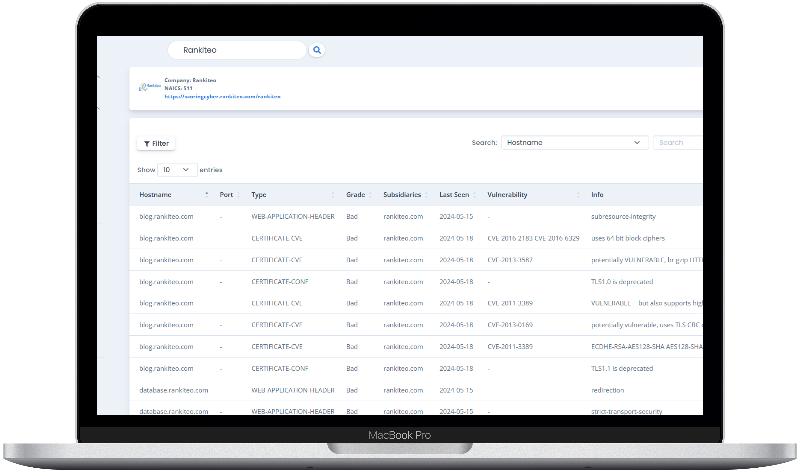
Identify exposed access points, detect misconfigured SSL certificates, and uncover vulnerabilities across the network infrastructure.
Gain visibility into the software components used within an organization to detect vulnerabilities, manage risk, and ensure supply chain security.
Monitor and manage all IT assets and their configurations to ensure accurate, real-time visibility across the company's technology environment.
Leverage real-time insights on active threats, malware campaigns, and emerging vulnerabilities to proactively defend against evolving cyberattacks.



 Rapid
Rapid